Forming a New Mexico LLC as a Non-US Person in 2026: $50 State Fee, No Annual Report, and Form 5472
A fact-checked guide to forming a New Mexico LLC as a non-US person, checked against the Limited Liability Company Act, the Secretary of State, TRD, FinCEN and
What this covers
A New Mexico limited liability company is often described as inexpensive to form, light on public disclosure, and free of a state annual report. The sections below check the usual reasons non-US persons look at New Mexico, and walk through one online filing path with a commercial registered agent, New Mexico Registered Agent. This guide does not add a referral or discount code.
This article checks those claims against the New Mexico Limited Liability Company Act (NMSA 1978, Chapter 53, Article 19), the Secretary of State, the Taxation and Revenue Department (TRD), FinCEN and the IRS. It does not invent hands-on testing. Turnaround times, vendor prices and “about three days to get the documents” in this guide come from user reports or case examples; they are not official promises. State fees, report obligations, tax and BOI follow the official pages. Forming the company is not the same as opening a bank account, getting an EIN or finishing tax filings. This is not legal or tax advice.
It is a different topic from the already published guide 159, on using a US LLC for an Apple Developer organization account. That article starts from an existing US LLC. This one is only about forming a New Mexico LLC and what official rules still apply afterwards.
Before you start
Keep these points separate:
- The Secretary of State keeps the company record. It does not handle federal tax. Filing articles of organization only forms the LLC in New Mexico. An EIN, Form 5472, a bank account and tax in your home country are separate steps.
- A quiet public record is not the same as anonymity. The articles are not required to list members or managers. That affects the Secretary of State’s public file only. A registered agent, a bank, a payment provider or the IRS may still ask who you are.
- No annual report does not mean no ongoing duty. The LLC must keep a New Mexico registered agent. If it goes 30 days without one, or 30 days after a change without filing a statement, the Secretary of State may administratively revoke it. See NMSA 1978 § 53-19-66.1.
- “Completely tax-free” overstates the federal picture. A default single-member LLC is generally a disregarded entity, so the company itself usually does not pay federal income tax as a corporation. Whether US federal income tax is actually due still depends on a US trade or business, effectively connected income (ECI), FDAP income that may be withheld, and your home-country rules. Disregarded status also does not cancel information reporting: a US disregarded entity wholly owned by a foreign person must file Form 5472, attached to a pro forma Form 1120, if it had a reportable transaction with a related party.
- A formation service is not a government office. The screenshots below come from a New Mexico Registered Agent checkout case. The statutory state fee to file articles is $50. The vendor total is a service price plus that state work, and you should confirm it on the page before you pay. This guide links only the public pages and does not add a referral parameter.
Do not use your own or a roommate’s residential address as the registered office. The registered office must be a New Mexico street address, usually the registered agent’s place of business. A separate contact or mailing address is allowed. It does not replace the agent.
Why people look at New Mexico
These are the points most often raised, set against official rules.
Less disclosure on the public file. NMSA 1978 § 53-19-8 says the articles must set out a compliant name; the street address of the initial registered office and the name of the initial registered agent at that address; the street address of the current principal place of business if it differs; the period of duration if it is not perpetual; a statement if management is vested to any extent in a manager; a statement if the company may carry on its affairs as a single-member LLC; and any other provision the signers choose to include. The section does not require names, addresses or ownership percentages of members or managers. What the public usually sees is the company name, the registered agent and address information. If a vendor form offers “List With the State” or “Omit From the State,” omitting names is using that statute. It is not a separate “anonymous licence.”
No annual report to the Secretary of State. The LLC fee schedule in § 53-19-63 has no line for an annual or biennial report, and the only grounds for administrative revocation in § 53-19-66.1 concern the registered agent, not a missed report. The Corporate Reports Act (NMSA 53-5) applies to corporations. There is therefore no annual-report due date and no revocation for missing one. The other side of that is that the state will not prompt you each year to confirm the file. If the agent or the address changes, you file a statement of change yourself. That fee is $20 (§ 53-19-63 I).
A low Secretary of State filing cost. The statutory fee to file original articles of organization and issue a certificate of organization is $50 (§ 53-19-63 A). The office does not charge an LLC an annual report fee. A commercial registered agent charges its own price, which is not a state fee. The claim that New Mexico is “one of the lowest-maintenance states in the country” is a comparison, not an official ranking. If you actually operate in another state, that state’s foreign registration and report may still apply.
Tax has to be read on three levels.
- Federal income tax: a domestic single-member LLC is disregarded by default; a multi-member LLC is a partnership by default (generally Form 1065). If the business is conducted entirely outside the United States and there is no US trade or business and no ECI, foreign-source income often is not subject to US federal income tax — that is a facts-and-circumstances question, not an automatic result of the certificate. A foreign-owned US disregarded entity that had a reportable transaction with a related party must still attach Form 5472 to a pro forma Form 1120 and file by the Form 1120 due date, including extensions. The IRS assesses $25,000 for a failure to file a complete and correct Form 5472 as required. If the failure continues more than 90 days after IRS notice, an additional $25,000 applies for each 30-day period or part of a period; that continuation penalty has no maximum.
- New Mexico income tax: TRD says pass-through entities doing business in the state generally file a New Mexico return. The definition of “pass-through entity” for that purpose excludes a single-member LLC treated as a disregarded entity for federal tax. If you have no business, property or employees in New Mexico, you typically will not meet corporate income tax nexus; an election to be taxed as a corporation, or actual business in the state, needs a fresh look at TRD’s rules. The $50 corporate franchise tax sits in the corporate tax regime. It is not an automatic annual state fee on every default disregarded LLC.
- Gross receipts tax (GRT) applies when you are “engaging in business” in New Mexico. TRD defines that as carrying on an activity for a direct or indirect benefit. A person without physical presence is engaging in business if, in the previous calendar year, taxable gross receipts sourced to New Mexico were at least $100,000. Examples of physical presence include a business location, property stored in the state, employees, a contract with a salesperson or other agent, leased equipment used in the state, or services performed in the state. The official page does not say whether a statutory registered agent alone is that kind of “agent.” This guide does not decide that question. Forming the company, by itself, is not the same as doing business in New Mexico. When a Business Tax Identification Number is required, TRD says registration has no fee.
Formation is not limited to US citizens. Section 53-19-7 says one or more persons may form an LLC by filing articles with the Secretary of State, and the organizers need not be members. The Act does not make US citizenship, a green card or New Mexico residency a condition of formation. Banks, payment firms and the IRS can still ask for identification, and a licence may still be required for regulated activity.
Beneficial ownership information (BOI). It is sometimes said that, from August 2026, under a FinCEN final rule, a US-formed LLC is exempt from BOI reporting even if it is wholly foreign-owned. That matches the Treasury press release of 11 August 2026 and the FinCEN final rule that became effective on 14 August 2026: domestic reporting companies formed under US law are permanently exempt from reporting BOI to FinCEN, locking in the March 2025 interim approach. The test is formation under US law, not the nationality of the owners. A foreign-formed entity that only registers to do business in a US state may still have to report foreign beneficial owners. Check FinCEN and the Federal Register final rule for the current text.
Steps
1. Check the name on the Secretary of State site
The official search is Business Search. “No records found” is sometimes treated as a green light. That only means the name does not already appear in the records that have been loaded. The name must still satisfy § 53-19-3: it must contain “limited liability company” or “limited company,” or the abbreviation L.L.C., LLC, L.C. or LC (“limited” may be “ltd.” and “company” may be “co.”), and it must be distinguishable from existing New Mexico LLCs, limited partnerships and corporations, from foreign LLCs or corporations authorized in the state, and from reserved names. The search page shows how far the office has processed incoming filings; on 13 November 2026 it stated that filings received through 29 October 2026 had been processed. A very recent filing may not be searchable yet. A name reservation is optional and costs $20 for 120 days (§ 53-19-63 H).
2. Search federal trademarks (optional, but worth doing)
It is also worth checking USPTO Trademark Search. That is a sensible conflict check. It is not a legal clearance, and a clean search is not a right to use the name.
3. Appoint a New Mexico registered agent
Section 53-19-5 requires a registered office in New Mexico and a registered agent for service of process at that address. The agent may be an individual resident of New Mexico, or a domestic or authorized foreign corporation, LLC or partnership whose place of business in New Mexico is the same as the registered office. A change of agent or office is filed with the Secretary of State and costs $20.
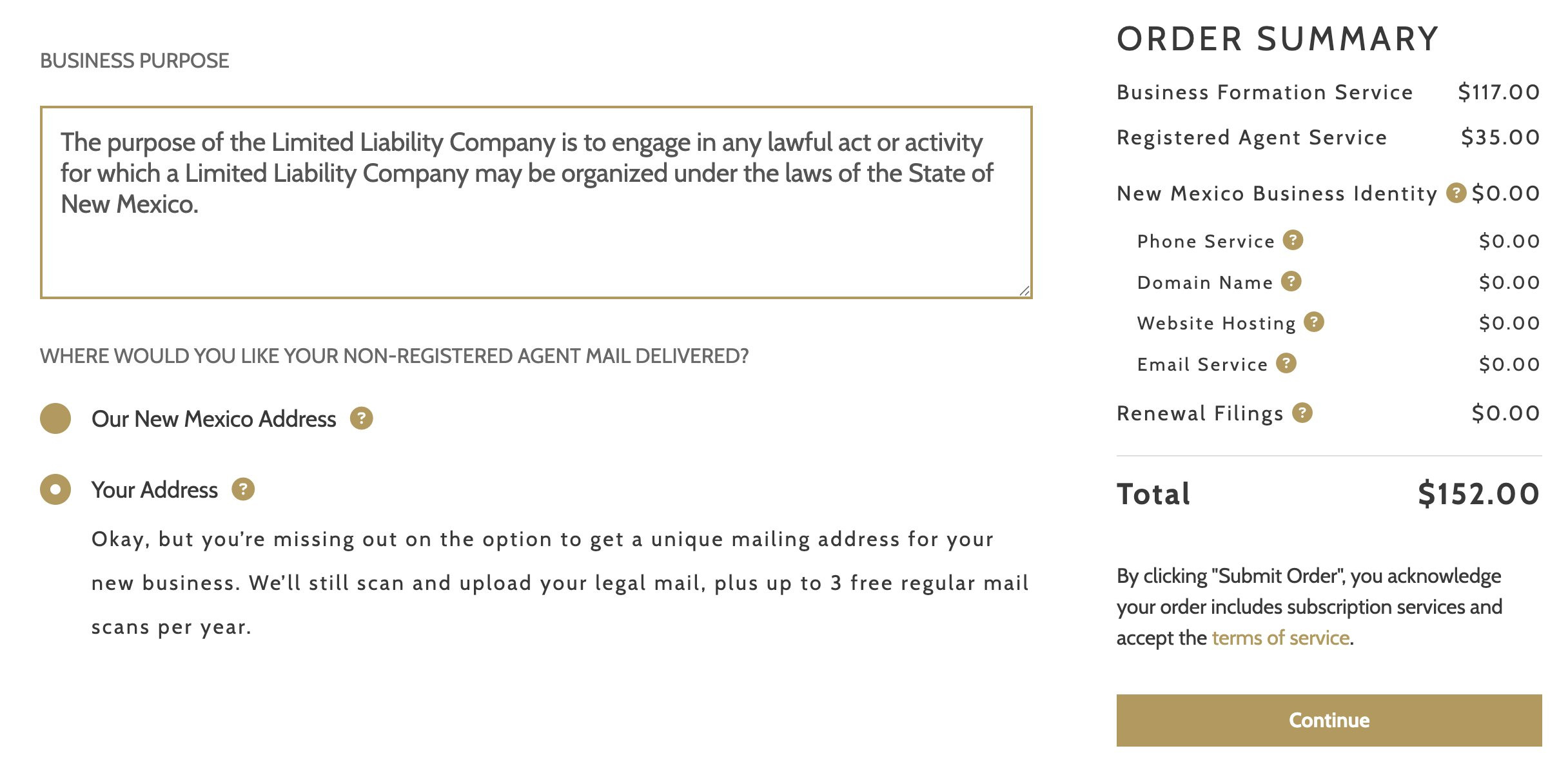
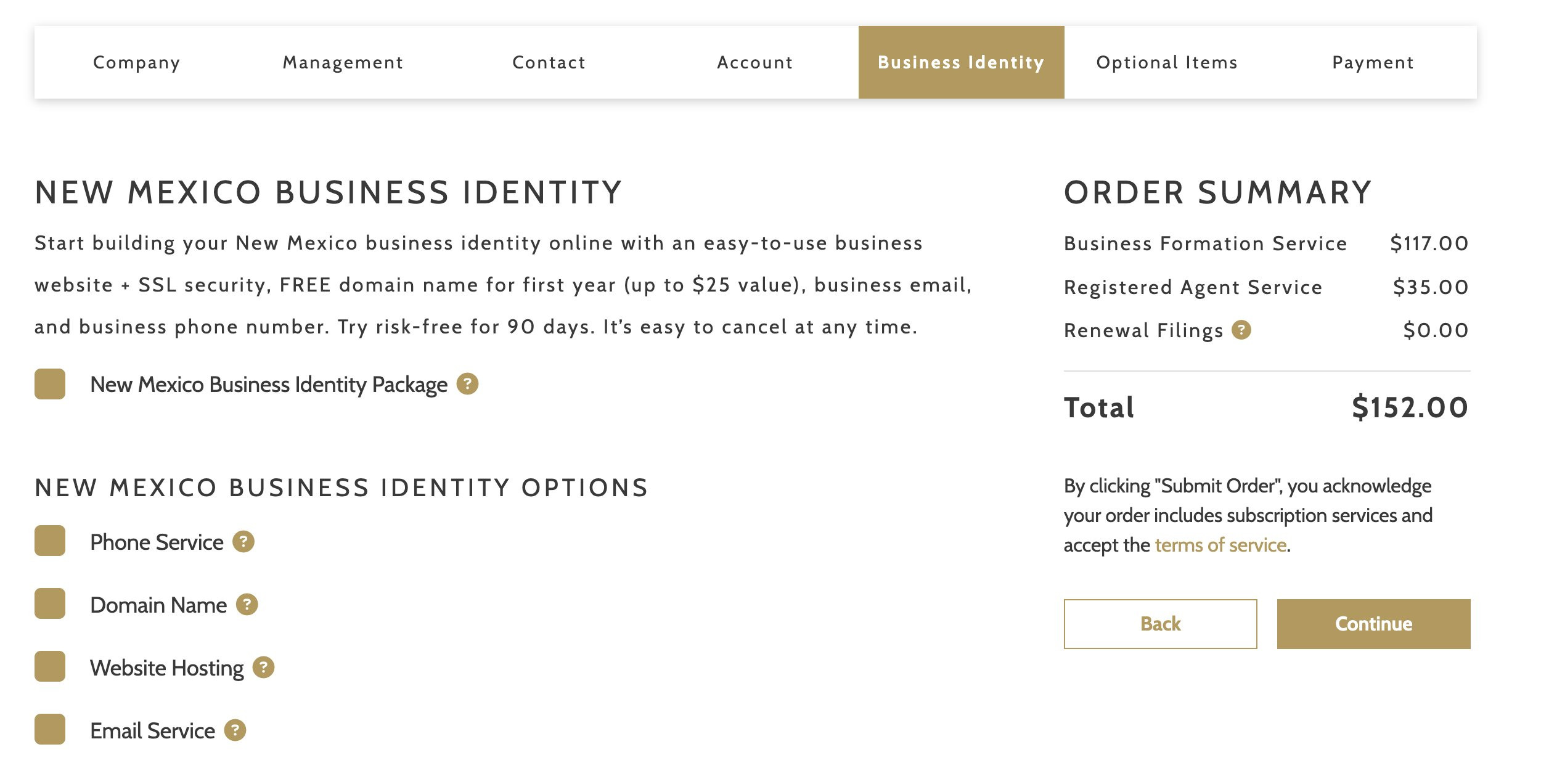
You can file directly through SOS Enterprise if you already have a qualified agent and the agent’s signed acceptance. Official business filings are made online. The walkthrough below uses a commercial provider, New Mexico Registered Agent, whose site advertises registered-agent service at $35 a year. In an October 2026 checkout case, Business Formation Service was $117.00 and Registered Agent Service was $35.00, for a total of $152.00. Optional Business Identity add-ons (website, domain, email, phone) were left unchecked at $0.00. The $117 formation line is not a fixed price on the marketing homepage, so confirm the current checkout total before you pay. That total is an individual case, not an official promise. The firm is not the only lawful option and it is not a state office.
4. Complete the vendor form (a user-case path and screenshots; not an official promise)
The case used this general purpose clause:
The purpose of the Limited Liability Company is to engage in any lawful act or activity for which a Limited Liability Company may be organized under the laws of the State of New Mexico.
That is a common catch-all. Section 53-19-8 does not require a detailed business purpose in the articles. Follow the form you are actually filing.
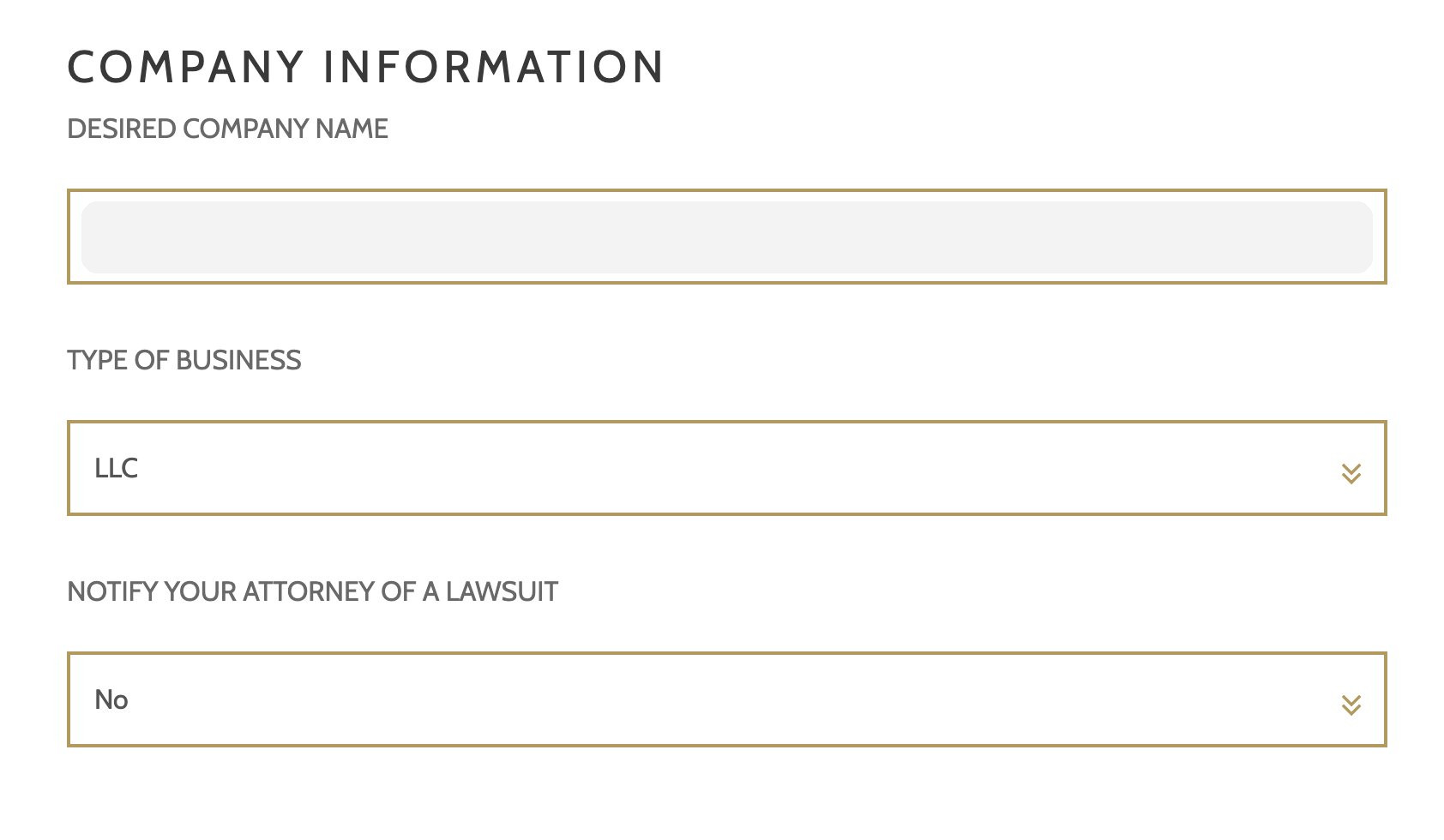
The company-name field in the original screenshot has been masked.
Under the purpose box, the form asks where non-registered-agent mail should go. In this case the “Our New Mexico Address” add-on was not purchased, and “Your Address” was selected. The total remained $152. The vendor still offered to scan and upload legal mail, plus up to three free regular-mail scans a year. Users have reported using a US Anytime Mailbox (ATMB) address as the contact address. That is a mailing address, not the registered office, and it should not be a private residential address. For ATMB itself, see guide 83.
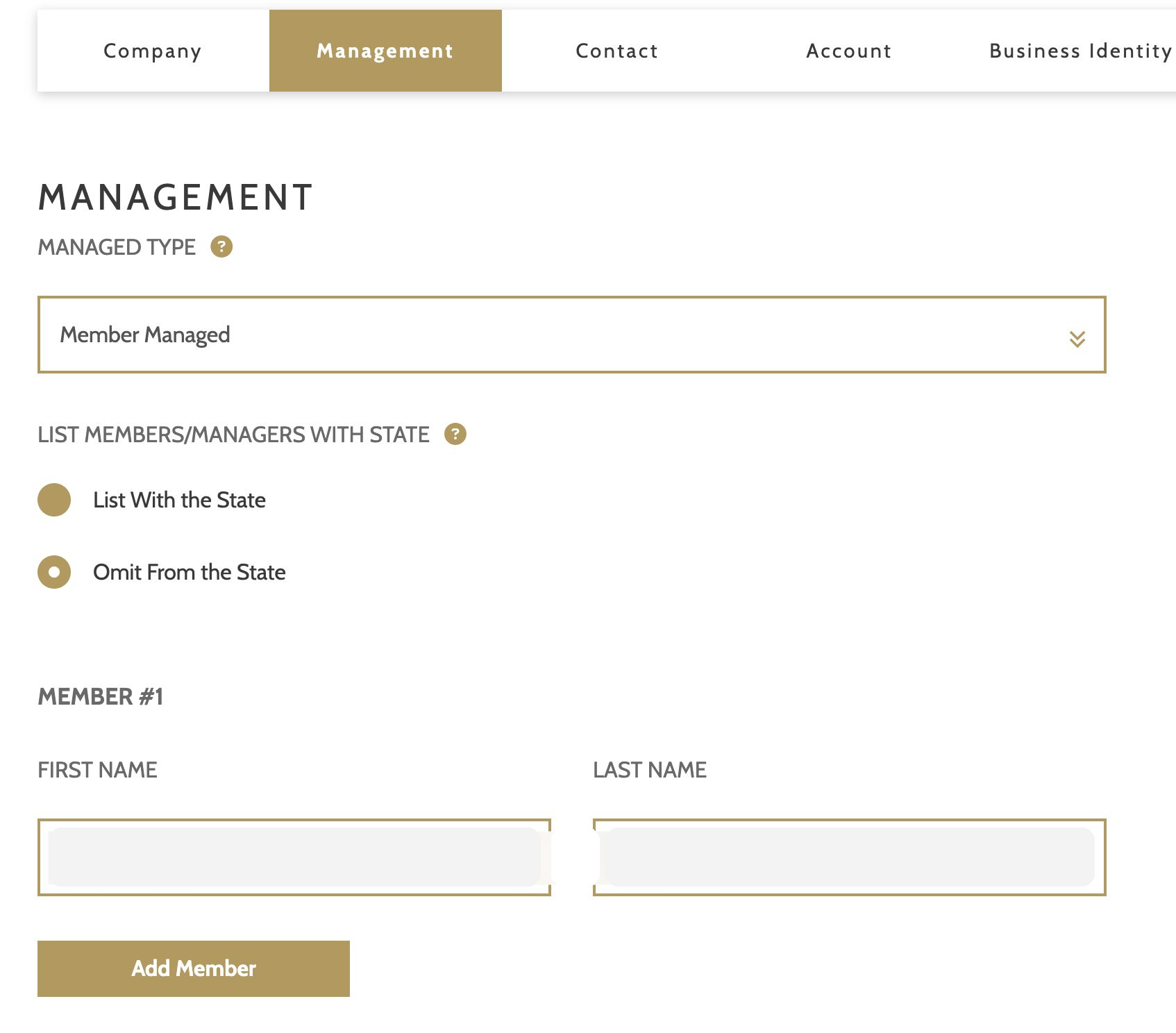
On management, this case chose Member Managed and Omit From the State, so member or manager names were not listed with the state. That is consistent with § 53-19-8, which does not require those names in the articles. The names in the screenshot have been masked.
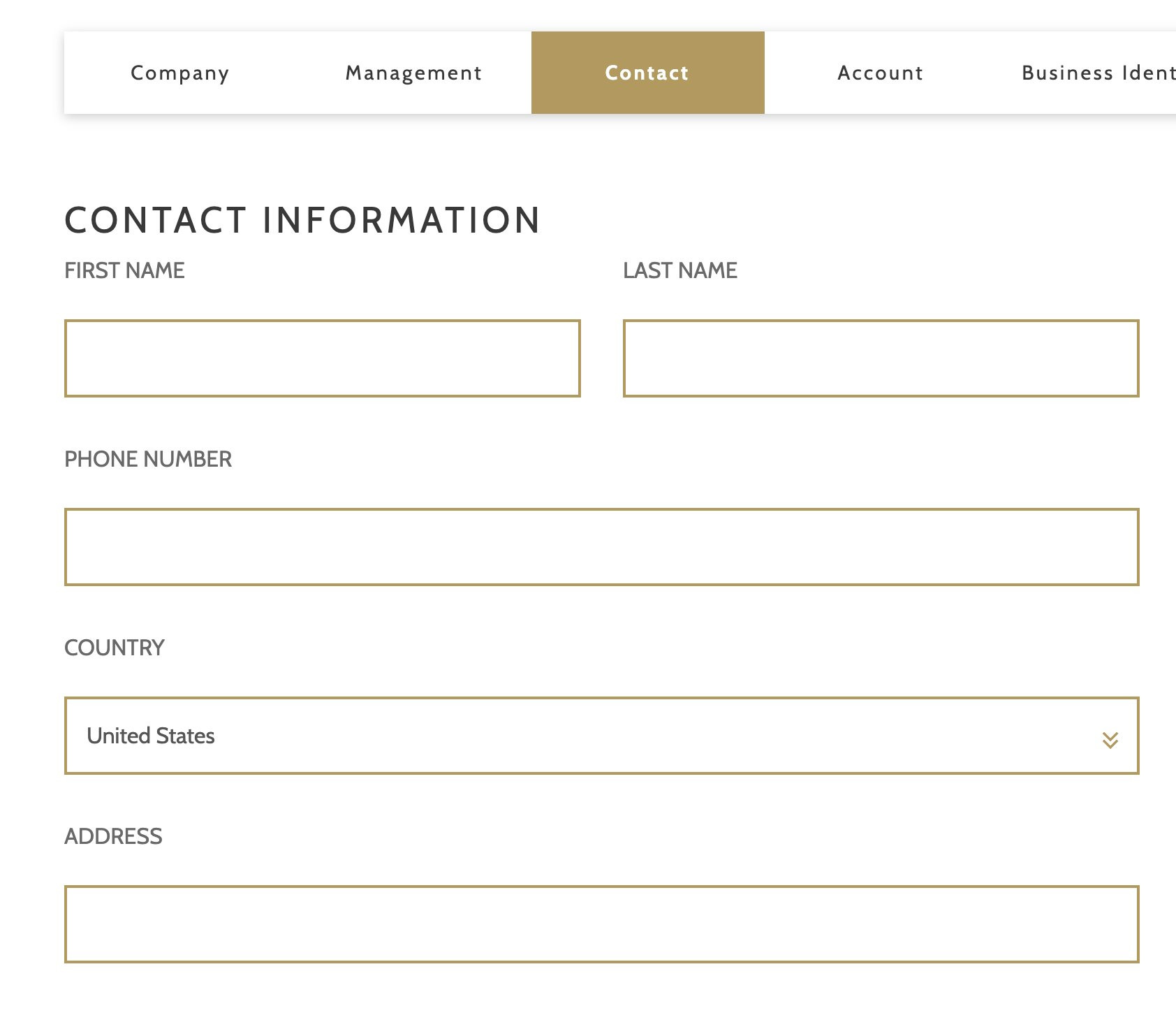
Contact details include name, phone, country and address. Users have reported entering a US ATMB address. The screenshot below is a blank form, shown so you can see the fields.
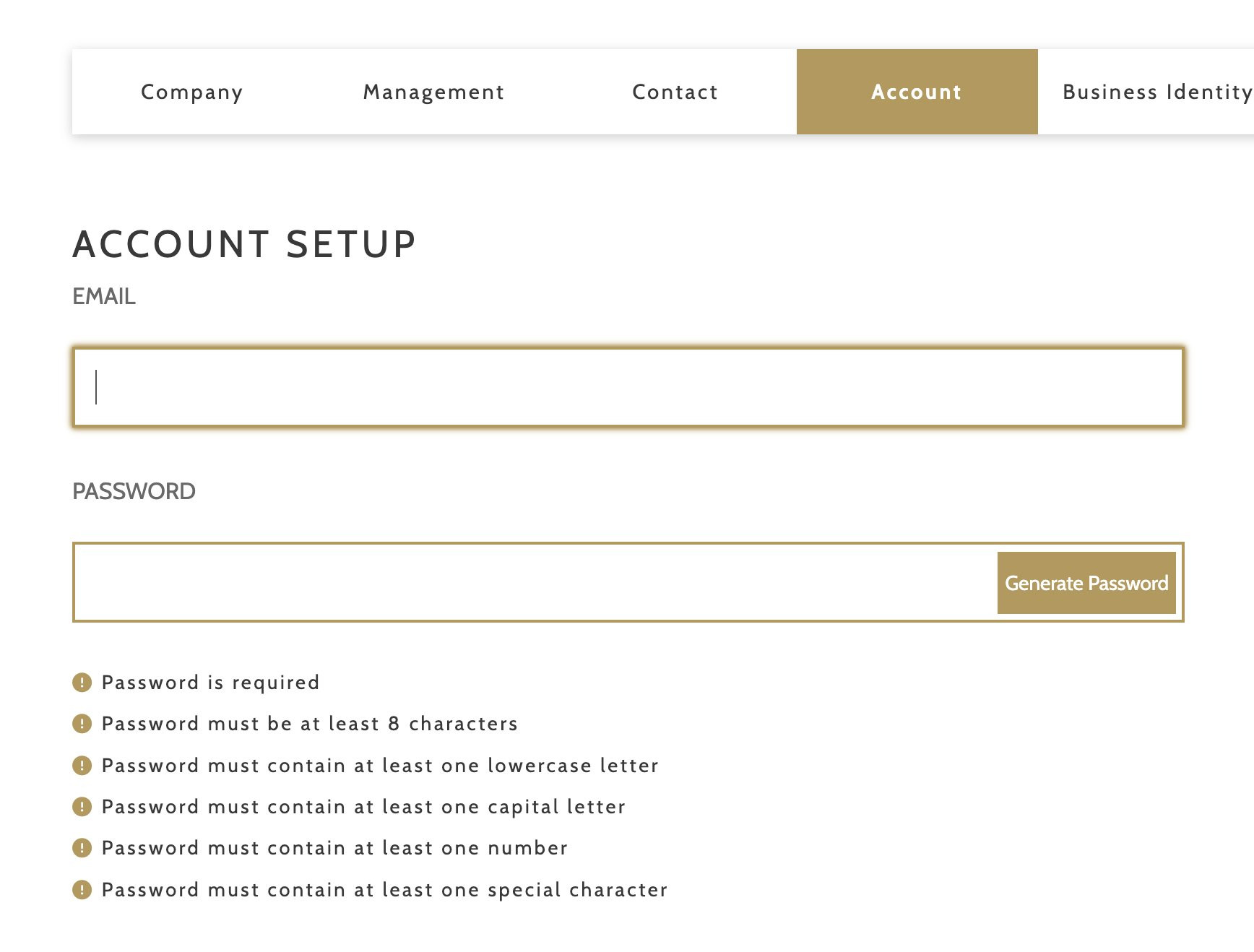
Next is account setup. The page lists the password rules: at least eight characters, with a lowercase letter, an uppercase letter, a number and a special character.
Watch for upsell packages at checkout and decline any you do not need. The checkout offers a New Mexico Business Identity Package (website, first-year domain, business email and phone, advertised as cancellable within 90 days). In this case those items were left unchecked. The summary stayed at $117 for formation plus $35 for the agent, or $152.
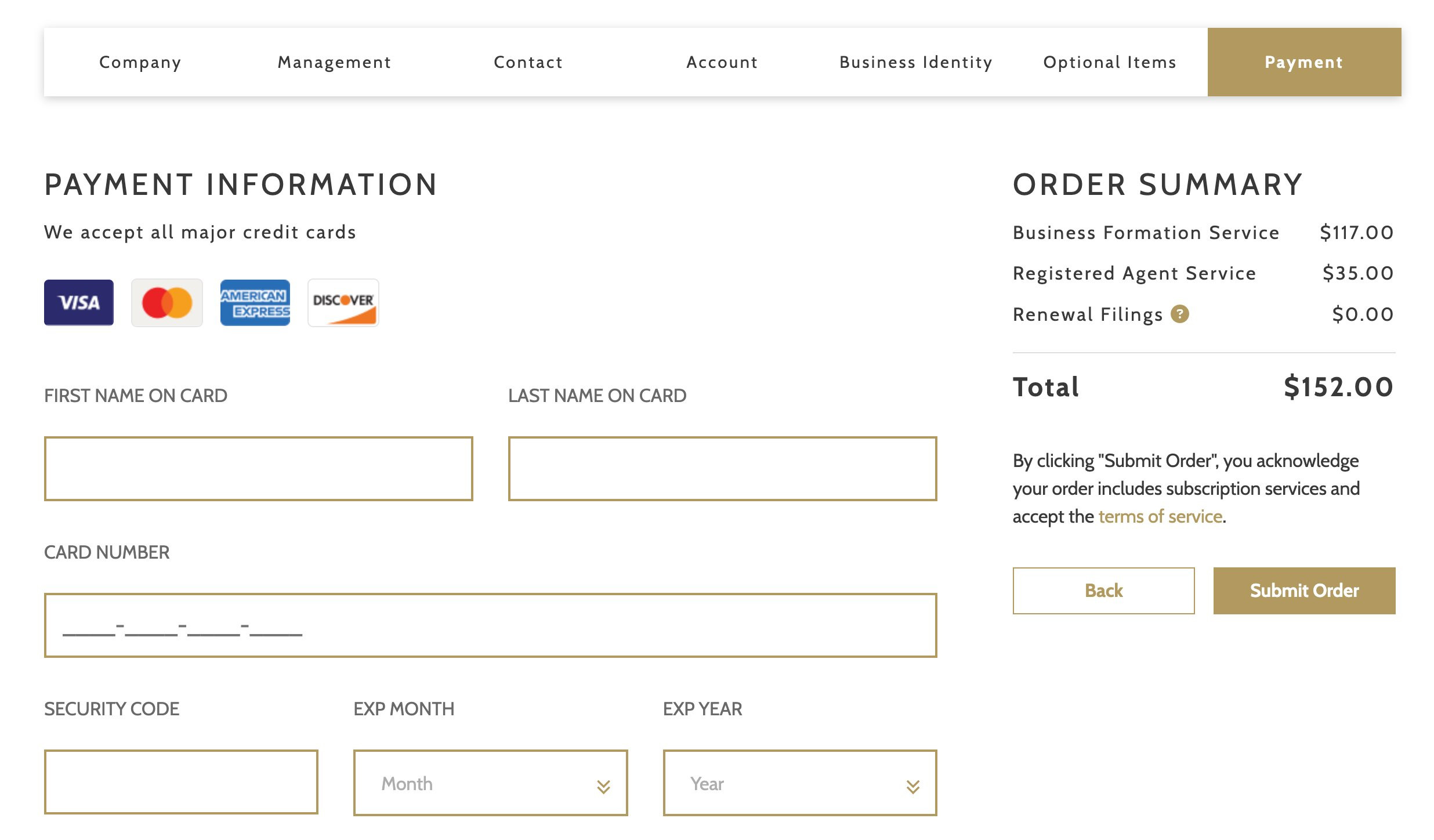
The payment page accepts major cards and repeats the $152 total. Check once more that no add-on has been ticked again before you submit.
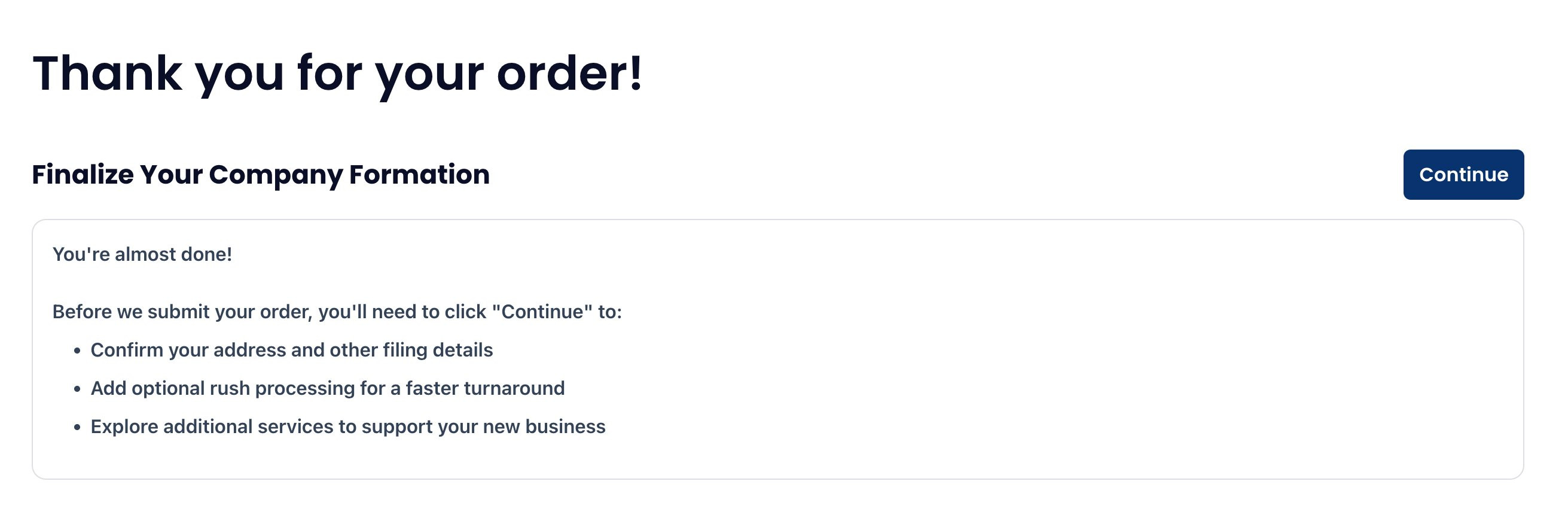
After payment, a thank-you page asks you to click Continue to confirm the address and filing details. It may also offer rush processing or more add-on services.
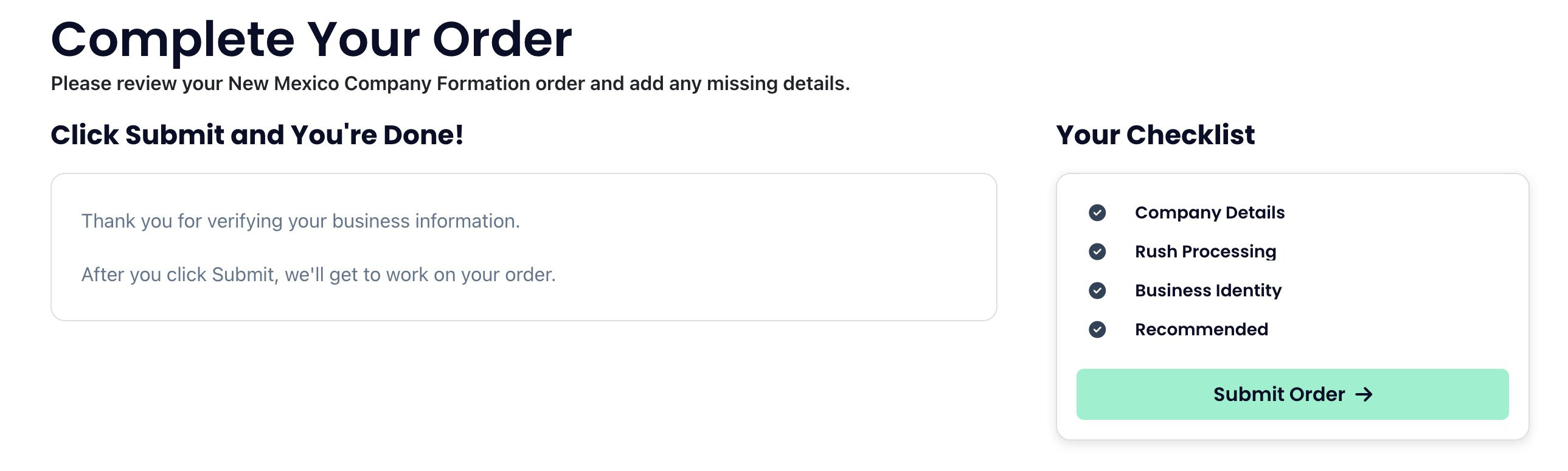
The last page is Complete Your Order / Submit Order. When you confirm the order, use the address the agent provides — that means the registered office, not a personal address.
5. Wait for the formation documents
Users have reported that they were not asked for identity documents during this process and received a formation notice after about three days. The agent sent two packs: a Formation Document containing a Notice of Filing Approval (the materials typo’d this as “filling”), Articles of Organization, a Statement of Acceptance of Appointment as Registered Agent, and a Certificate of Organization; and a set of Initial Resolutions. The articles and the certificate of organization are the state formation documents. The agent’s acceptance commonly accompanies the articles. Initial resolutions are usually an internal document prepared by the vendor, not a required Secretary of State form.
“About three days” and “no identity documents” are user reports with this vendor. They are not a published statewide processing time, and they are not an official promise that no identification will ever be required. The vendor’s own account rules, an EIN application, or a later bank or payment-account review may still ask for documents.
6. Apply for an EIN (separate from state formation)
It is sometimes said that you can apply for an EIN on Form SS-4 by mail or fax without an SSN or ITIN. The IRS Instructions for Form SS-4 (revised December 2025) say:
- The online application is only for applicants who have a legal residence, principal place of business, or principal office or agency in the United States or a US territory, and the responsible party must have a valid SSN, EIN or ITIN.
- International applicants without those US locations cannot use the online application. They may call 267-941-1099 (not toll-free), 6:00 a.m. to 11:00 p.m. Eastern time, Monday to Friday, or fax or mail Form SS-4.
- On line 7b, if the responsible party does not have and is ineligible to obtain an SSN or ITIN, enter “foreign” or N/A. An entry is required.
A New Mexico LLC is a domestic entity. How you describe its principal place of business, and whether the international phone line is the right channel, follows the SS-4 instructions and the IRS classification that day. Do not assume that every foreign-owned domestic LLC can file online, or that every one must use the international fax. If the EIN is requested so that a foreign-owned US disregarded entity can file Form 5472, the instructions say to check Other on line 9a and write “Foreign-owned U.S. disregarded entity-Form 5472.”
7. After the company exists
- Keep a qualified New Mexico registered agent, and file a change with the Secretary of State within 30 days if the agent or office changes.
- If a foreign-owned single-member LLC had reportable transactions with a related party, file Form 5472 with a pro forma Form 1120 on time. A multi-member LLC classified as a partnership generally also files Form 1065. The penalties are steep; do not skip the information return only because “the business is not in the United States.”
- If you later engage in business in New Mexico, or meet TRD’s economic-nexus threshold, register for a Business Tax Identification Number and deal with GRT as required. Formation and doing business in the state are not the same event.
- Member names can stay off the Secretary of State’s public file, but banks, payment firms and the IRS can still collect beneficial-owner information. Under the final rule effective 14 August 2026, US-formed companies are exempt from reporting BOI to FinCEN. That exemption does not stop other institutions from verifying identity.
In short
Forming a New Mexico LLC, under the statute, centres on articles that satisfy § 53-19-8, a $50 filing fee, and a New Mexico registered agent you keep in place. An LLC does not file an annual report with the Secretary of State, and the articles need not list members or managers. Those points can be checked in NMSA 1978, Chapter 53, Article 19.
The example path is an online filing through New Mexico Registered Agent. In one October 2026 case the checkout total was $152, including one year of registered-agent service, and documents arrived in about three days. That is a user case and screenshots, not a statewide fee or deadline, and not an official promise. After formation, an EIN and Form 5472 still follow IRS rules. US or New Mexico income tax, and gross receipts tax, depend on what the company actually does and where it has nexus — not on the certificate alone. A quieter public file is not total anonymity, and default pass-through treatment is not a blanket tax exemption. Follow the Secretary of State, TRD, FinCEN and IRS pages as they stand when you file.
Sources
- New Mexico Secretary of State: statutes governing business (including NMSA 53-19)
- New Mexico Secretary of State: Business Search / SOS Enterprise
- NMSA 1978 (2025 compilation text): § 53-19-3 Name, § 53-19-5 Registered office and agent, § 53-19-7 Formation, § 53-19-8 Articles of organization, § 53-19-63 Fees, § 53-19-66.1 Administrative revocation
- New Mexico TRD: Who must register a business, Determining nexus, Pass-through entity
- US Department of the Treasury: FinCEN final-rule press release, 11 August 2026
- Federal Register: Beneficial Ownership Information Reporting Requirement Revision, effective 14 August 2026
- FinCEN: final-rule questions and answers (PDF)
- IRS: Instructions for Form 5472, Instructions for Form 1120, International information reporting penalties, Instructions for Form SS-4 (December 2025), Employer identification number
- USPTO: Trademark Search
- Commercial vendor (not a government site): New Mexico Registered Agent formation page, homepage (advertises $35/year registered-agent service)
- Related Carddoger guides: 159, US LLC and Apple Developer organization enrollment, 83, Anytime Mailbox