Opening a Freedom Bank Account via Kazakhstan eResidency in 2026: The Official $49 Path, IIN, eSIM, and Mastercard
How to open a Freedom Bank account through Kazakhstan eResidency’s official $49 Freedom Banker path, with official corrections on the IIN, Mastercard-only issua
Kazakhstan’s national eResidency programme can be used with partner bank Freedom Bank to complete remote identity checks on a real passport and then open an eResidency card in the Freedom Banker app. This guide follows official pages, official support articles and the programme Terms of Use as checked on 20 November 2026. Several common claims need correcting up front: this Freedom Bank path currently issues Mastercard only, not a Visa-or-Mastercard choice; the IIN is not a tax number and does not confer entry, residence or tax residency; a physical card can be ordered, but delivery is paid, and whether a given country is served is shown in the app at checkout.
Partner banks decide independently whether to open an account, and fees or delivery coverage can change. What matters is the confirmation screen before you pay, the bank’s review, and the official documents then in force. This is not immigration, tax or investment advice.
What this is — and what it is not
eResidency is a national programme of the Republic of Kazakhstan. The operator is Verum Payments Limited, registered in the Astana International Financial Centre (AIFC). The official Chinese site states, in substance also reflected on the English site, that the Digital Identity Card and IIN are for use in the electronic environment only; they are not a Kazakhstan citizen identity document and do not confer entry, residence or tax residency.
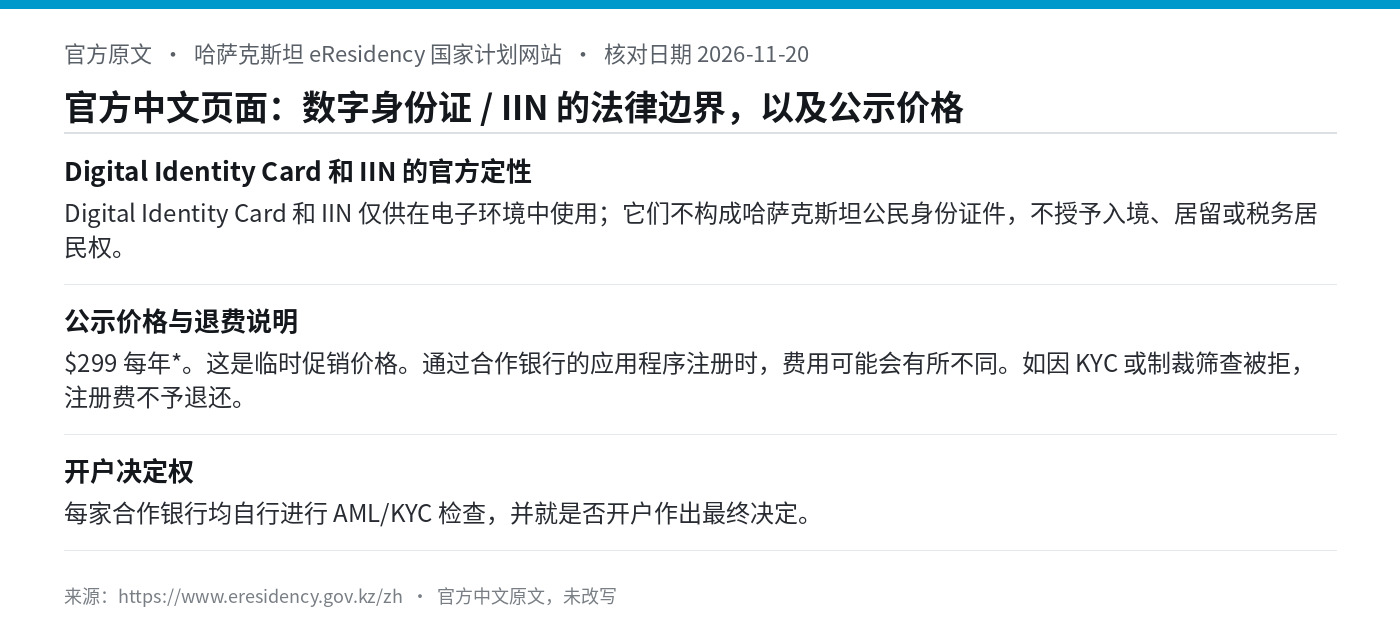
The Terms of Use (November 2026 edition) refer to the identifier issued under the programme as an e-Residency IIN, assigned by the Ministry of Internal Affairs of the Republic of Kazakhstan (MIA RK). Freedom Bank’s official FAQ adds that an IIN issued through eResidency has no expiry date under the law and is generated from the foreign passport. It is a standalone number, not linked to a national IIN, and cannot be converted, updated or replaced. Official support also states that this IIN is not the equivalent of a national IIN and cannot be used for eGov, eLicense or other state services.
Do not treat it as a permanent tax identification number, and do not expect the digital ID alone to confer entry, residence or tax residency in Kazakhstan. Each partner bank runs its own AML/KYC checks and makes the final decision on whether to open an account. Help with company registration is a separate service from partner eRes Consultancy Ltd and is not included in the eResidency fee; this guide covers only the bank-account path.
The official government site lists Freedom Bank as a live partner. Bank RBK and some other platforms are still marked “coming soon”. Banks that are not confirmed on the official list are not described here as already available.
Fees: do not mix up $49, $120 and $299
Three official sources have to be read together.
The official government website (Chinese page, checked on 20 November 2026) shows “$299 / year*”. The asterisk says this is a temporary promotional price; the fee may differ when you register through a partner bank’s app; and the registration fee is not refunded if the application is refused after KYC or sanctions screening.
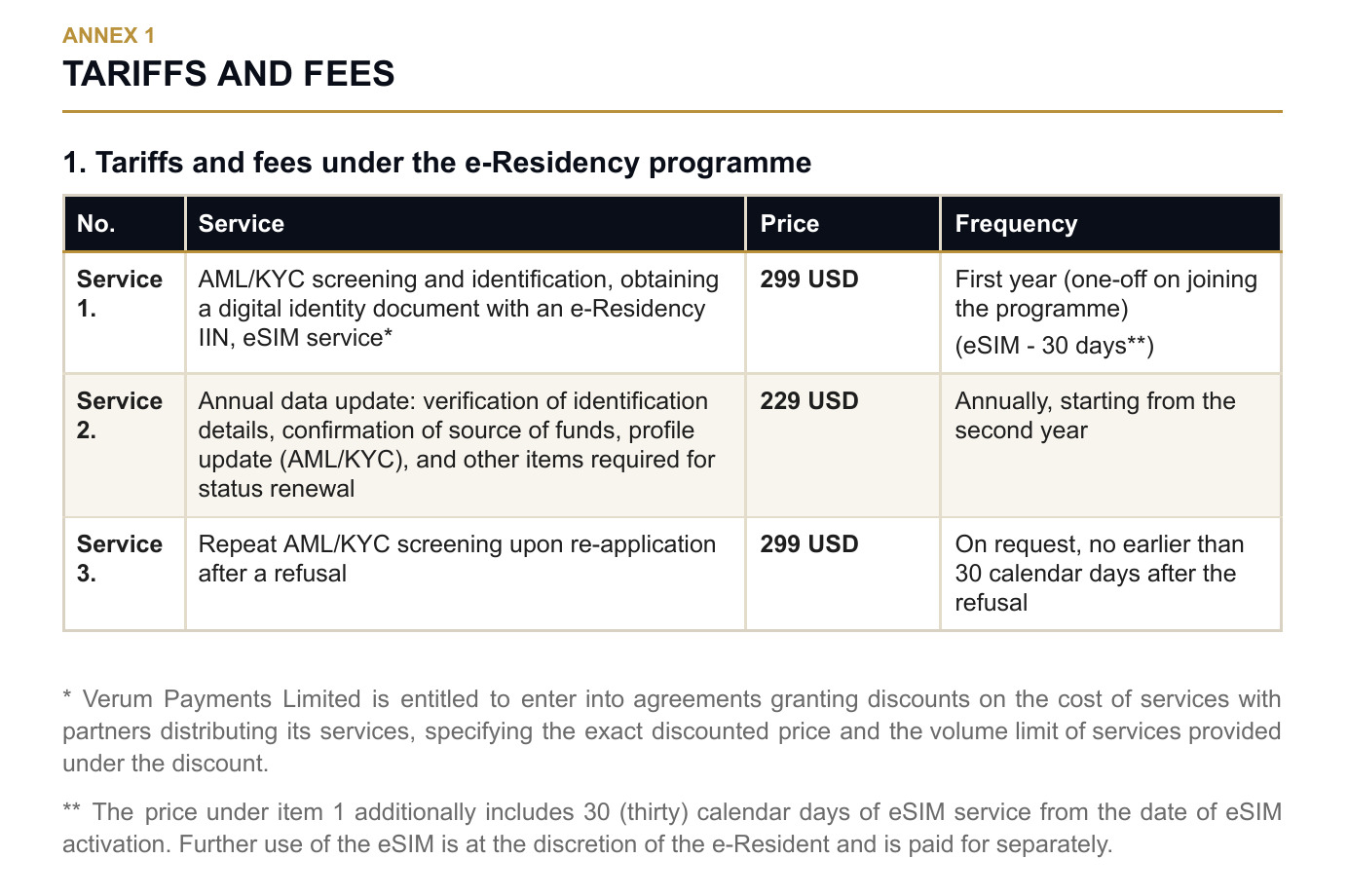
Annex 1 to the Terms of Use (November 2026, rev. 1) sets the operator’s tariff in more detail:
- Service 1: AML/KYC, a digital identity document with an e-Residency IIN, and eSIM service — 299 USD, one-off on joining (eSIM included for 30 calendar days).
- Service 2: “Annual data update” — 229 USD, annually from the second year.
- Service 3: Repeat AML/KYC after a refusal — 299 USD, no earlier than 30 calendar days after the refusal.
The Annex also allows Verum Payments Limited to agree discounted prices with distribution partners. Clause 9.3 says AML/KYC fees are non-refundable once verification has commenced, regardless of the outcome.
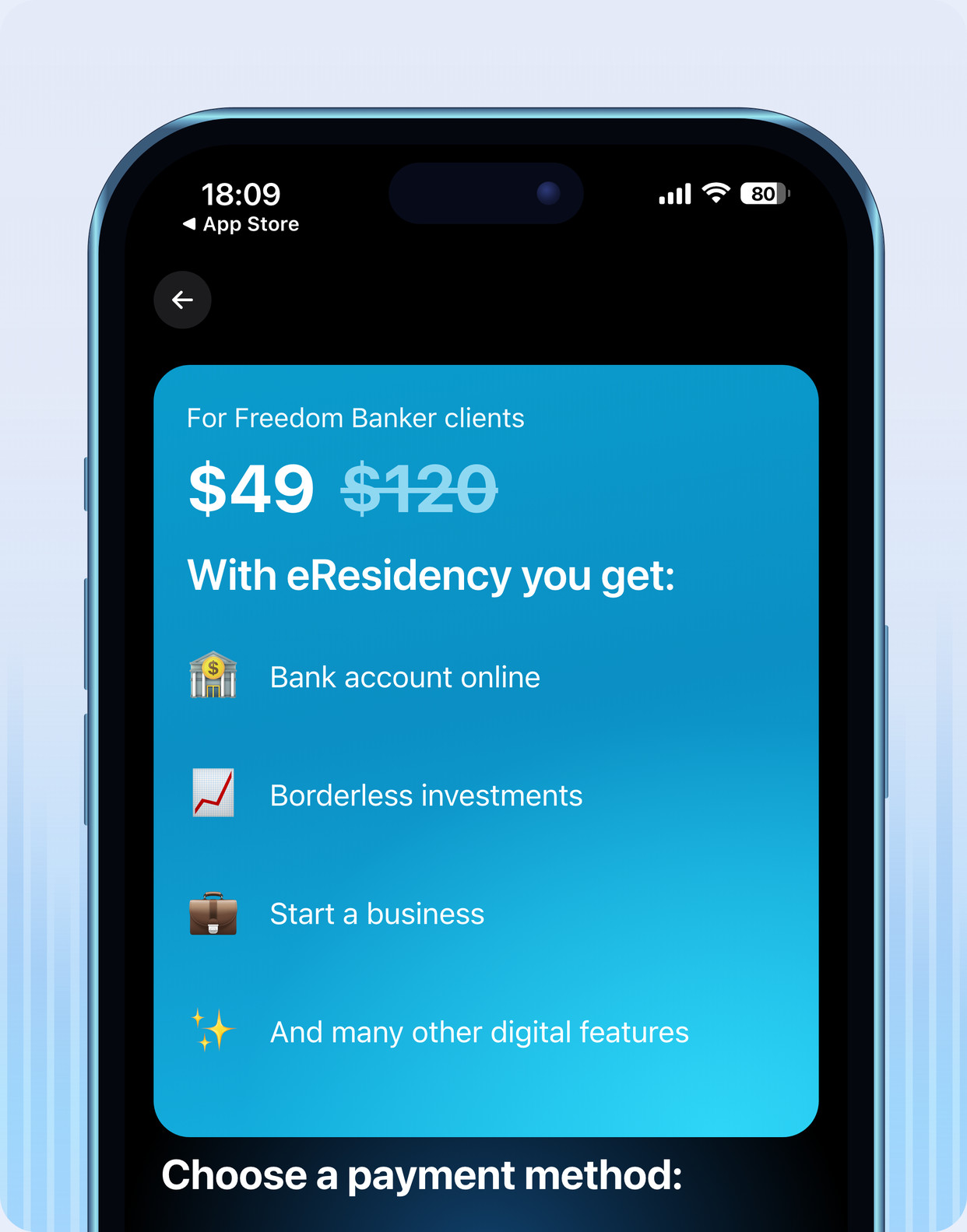
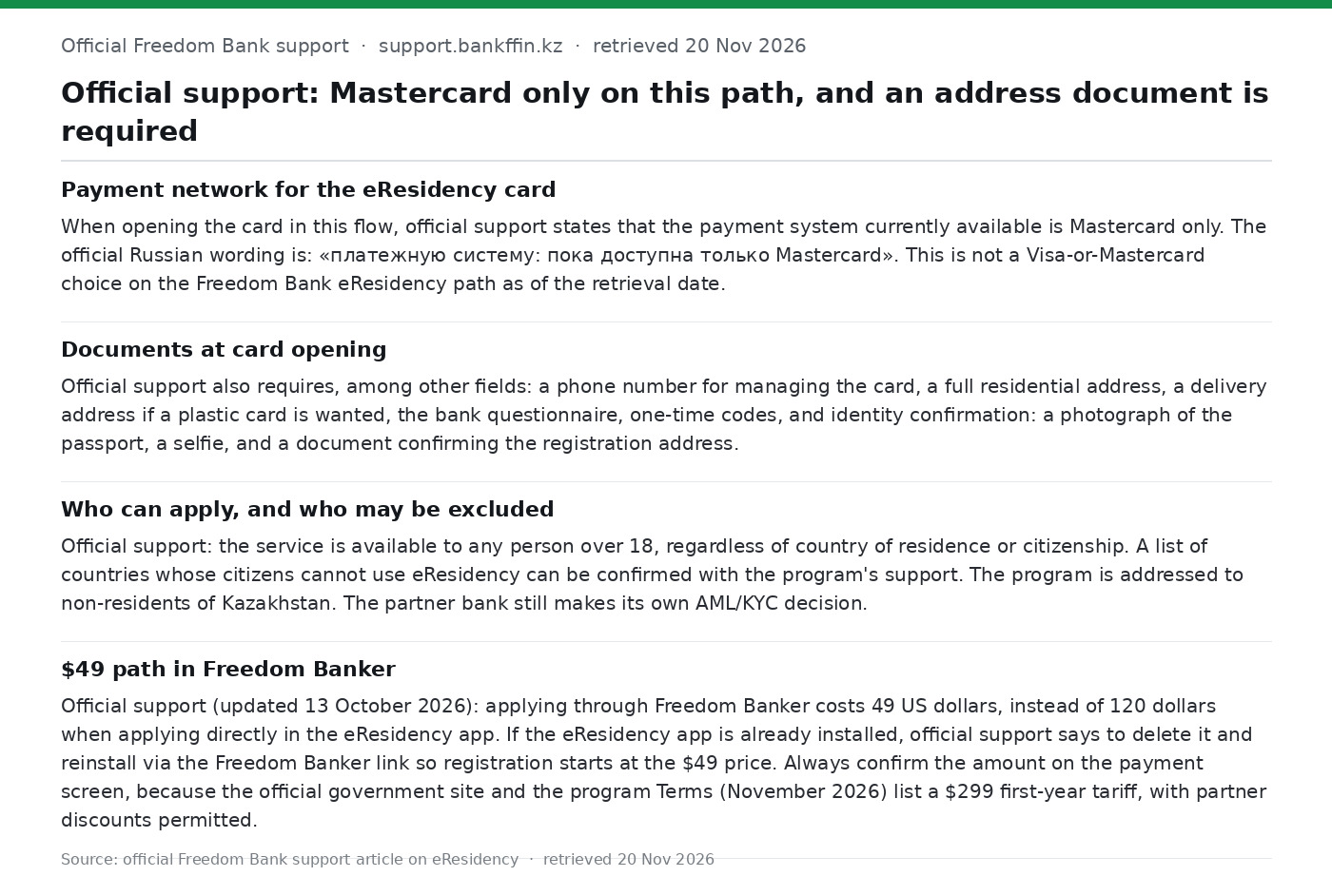
Freedom Bank’s official card page and official support describe a partner-bank discounted path: apply in Freedom Banker and the operator’s service fee is a one-time 49 US dollars. Official support (updated 13 October 2026) also says the price is 120 dollars if you apply directly in the eResidency app. The bank’s official how-to art shows $49 for Freedom Banker clients, with $120 struck through. That is not automatically the same as the $299 first-year tariff still published on the government site and in the Terms — partner discounts are permitted, but the amount on the payment screen is what counts.
If the eResidency app is already installed, official support says to delete it and reinstall via the link in Freedom Banker so registration starts at the $49 price. Freedom Bank does not collect this operator fee; official support lists payment by Visa, Mastercard and MIR, and by USDT or USDC subject to KYT / Travel Rule screening. Those are ways to pay the programme fee, not a statement that the bank card itself will be issued as Visa.
Freedom Bank’s official FAQ also separates two later charges. The first month of eSIM service is included in the eResidency fee; from the second month it costs 15 USD per month and can be topped up in the eResidency app if you want to keep it. A paid “Annual data update”, priced by the operator, is how e-resident status itself is maintained. The FAQ states clearly that this update is not required for the account and card to work, and that paying for the eSIM or the annual update does not affect the card or account. The Terms, however, also say that if the annual update is not completed in time, the participant’s status in the operator’s database may be switched to inactive. That does not annul the IIN, but partners — including banks — take their own decisions under their own terms. Read both official texts; do not rely on only one sentence.
Official path: start in Freedom Banker
Freedom Bank is part of Freedom Holding Corp. The official footer lists 050000, Almaty, Almalinsky district, Kurmangazy str., house 61a. Its licences are ARDFM Licence for banking and other operations No. 1.1.551.129 dated 7 July 2026, and ARDFM Licence for securities market activities No. 1.2.253/45 dated 12 June 2024. In-country support is 595.
The minimum age to open a card is 18. The official page requires a foreign passport with an NFC chip, valid for at least six months; a Kazakhstan IIN and a mobile number; and a Kazakh-operator eSIM for SMS, which can be obtained through the programme. Official support says any person over 18 may apply, regardless of country of residence or citizenship, but a list of countries whose citizens cannot use eResidency should be confirmed with the programme’s support. The programme is addressed to non-residents of Kazakhstan. Even with a genuine passport and genuine documents, the bank can still refuse the account.
The official card-page steps are:
- Download Freedom Banker, become a client, and apply for eResidency in the app.
- Complete verification in the eResidency app: use a biometric passport with an NFC chip, photograph the passport and upload the image as prompted.
- Pay the 49 USD operator fee.
- Activate the eSIM using the instructions sent by email.
- Return to Freedom Banker, log in with the eSIM number, complete the bank questionnaire, and open a new eResidency card or activate an existing one.
The official FAQ does not promise a “one to three business days” review. It tells you to wait for the operator and watch for eSIM instructions by email. The official how-to screen that says “Preparing your eSIM / This usually takes up to 2 minutes” refers to the usual time on the eSIM provisioning screen, not to the KYC review. When the card is ready, Freedom Banker shows the Mastercard eResidency card face.
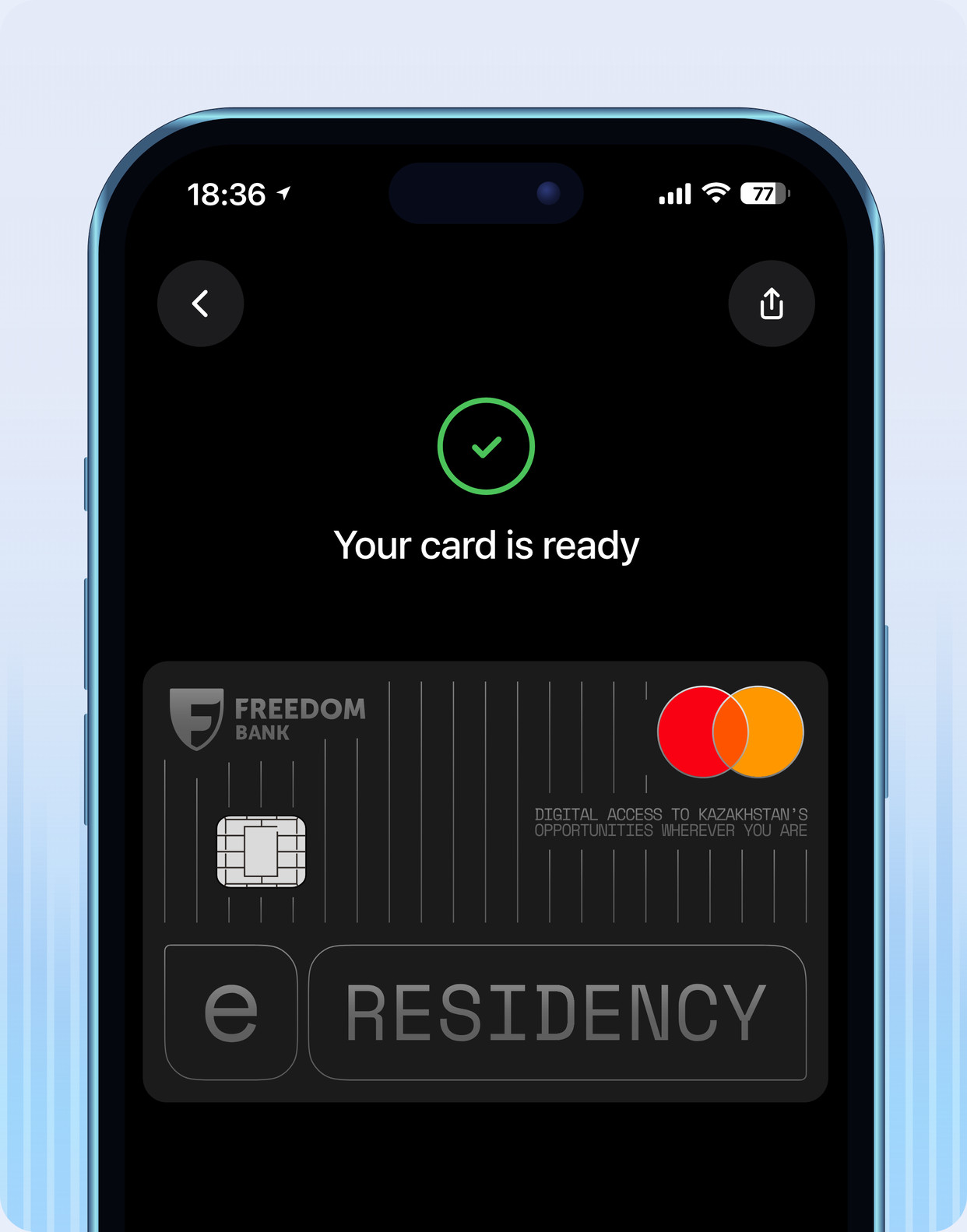
At card opening, official support also requires a phone number for managing the card, a full residential address, a delivery address if a plastic card is wanted, the bank questionnaire and one-time codes, plus identity confirmation: a photograph of the passport, a selfie, and a document confirming the registration address. Use real documents that match the applicant. Clause 10.1 of the official Terms prohibits false, forged, misleading or fraudulent documents, information or biometric data, and also prohibits using VPNs, device emulators, jailbroken devices or other technical means to interfere with, circumvent or compromise identification or verification.
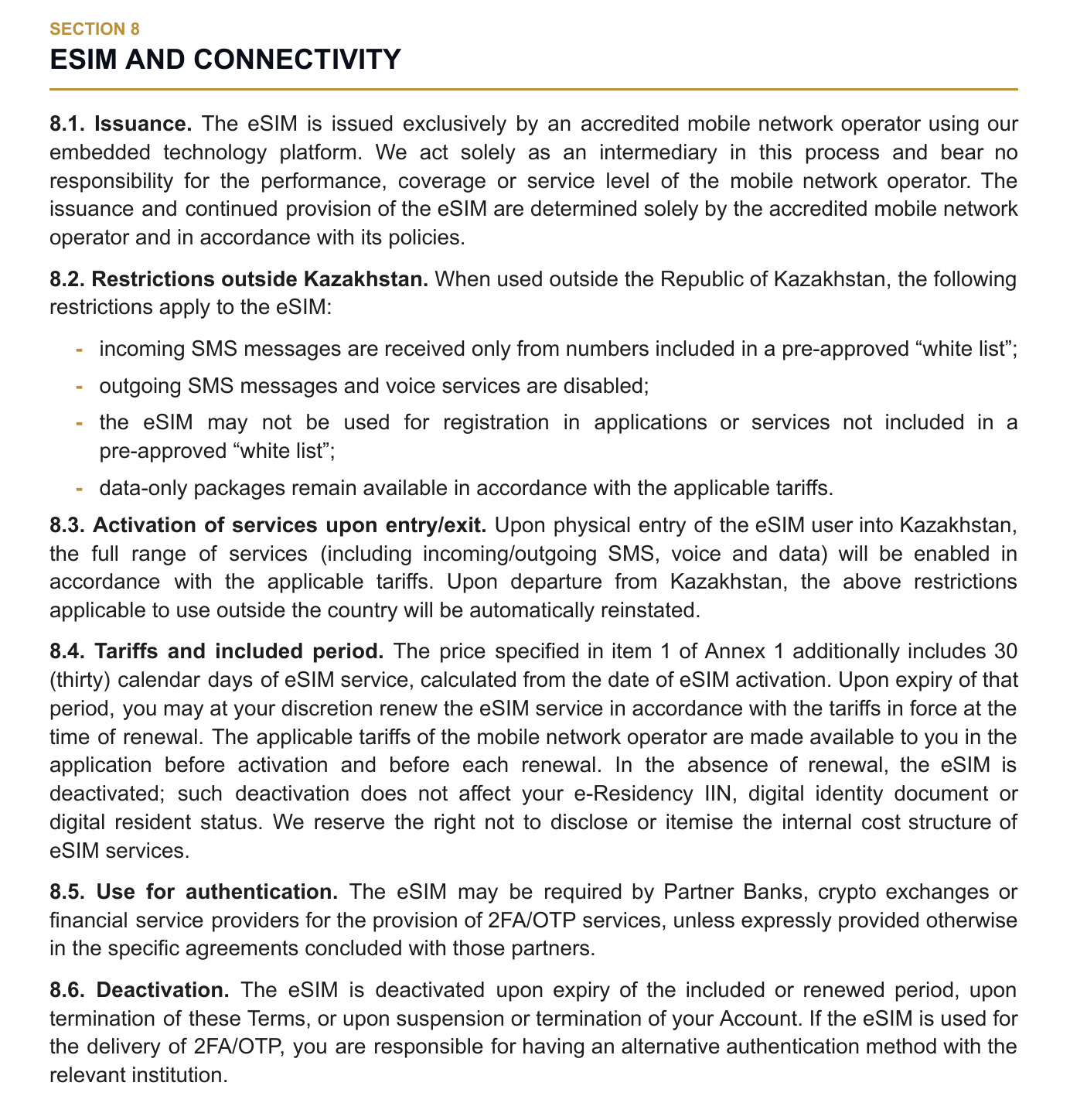
eSIM: overseas limits are in Section 8 of the Terms
The Kazakhstan-number eSIM is part of the programme; it is not an ordinary travel SIM. The device must support eSIM. On the official path, the eSIM is required for the first authorisation in Freedom Banker. Official support also notes that you can later specify your own phone number, and the Kazakhstan number may no longer be needed for banking. The eSIM is issued by an accredited mobile network operator; the programme operator is only an intermediary and is not responsible for network performance or service levels.
Section 8.2 of the Terms says that, when the eSIM is used outside Kazakhstan:
- incoming SMS is received only from numbers on a pre-approved “white list”;
- outgoing SMS and voice services are disabled;
- the eSIM may not be used to register in applications or services that are not on that white list;
- data-only packages remain available under the applicable tariffs.
On physical entry into Kazakhstan, incoming and outgoing SMS, voice and data are enabled under the applicable tariffs; the overseas restrictions are reinstated automatically on departure. Item 1 of Annex 1 also includes 30 calendar days of eSIM service from the activation date. After that, renewal is optional at the tariffs then in force; if it is not renewed, the eSIM is deactivated, which does not affect the e-Residency IIN, the digital identity document or digital resident status. Section 8.5 adds that partner banks, crypto exchanges or other financial service providers may still require the eSIM for 2FA / OTP, unless a specific agreement says otherwise.
The card, the accounts, and physical-card delivery
On this Freedom Bank eResidency path, official support says the payment system currently available when you open the card is Mastercard only. The government site, describing the programme as a whole, mentions that partner banks may involve Visa, Mastercard and UnionPay, as well as Apple Pay, Google Pay and Samsung Pay. That is a programme-level summary, not a statement that Freedom Bank currently lets you choose the network on this path. As of the date of this check, prepare for Mastercard.
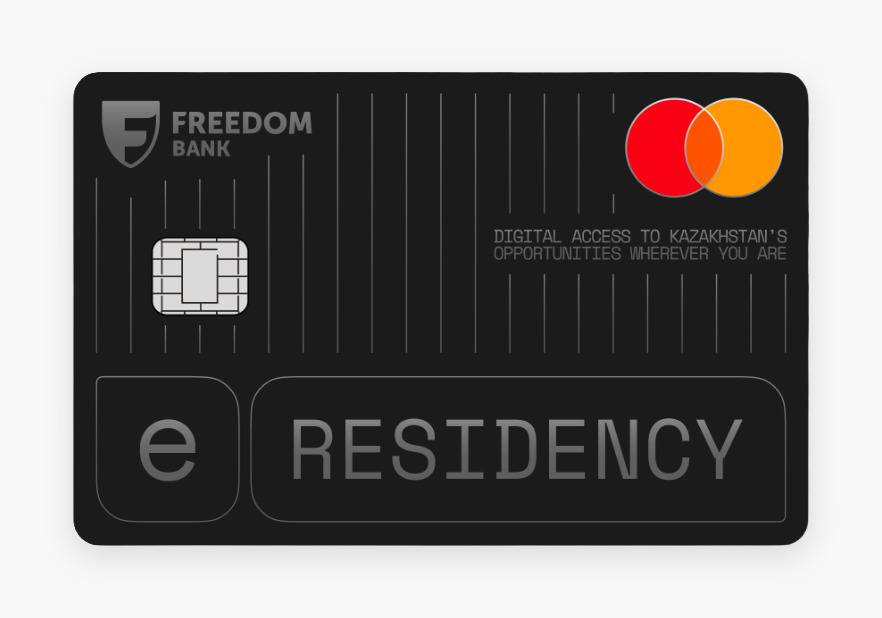
Official support also says that after status is granted you need to open a Deposit Card or SuperCard to enter the app with the new details. That card comes with two accounts (IBANs), in tenge (KZT) and US dollars (USD), and those two accounts cannot be closed. You can then open additional currency accounts in Freedom Banker. The official list includes EUR, RUB, TRY, AED, CNY, KGS, TJS and UZS. What is stated officially is the two default IBANs; whether each extra currency then receives its own IBAN should be read from the app, and is not inferred here. The official card page lists SWIFT for international transfers. Apple Pay, Google Pay and Samsung Pay also appear on that page and in the FAQ.
Marketing copy often refers to zero-tenge issuance, usage, top-ups or conversion, or to worldwide payments without extra fees. Check the live tariff schedule as well, and do not treat promotional wording as an unchangeable fee promise. Freedom Bank’s eResidency card page links a Deposit Card tariff file (the English file at the time of this check is tariffs_depositcard_en.pdf) and a “tariffs and limits” entry. Overseas ATM withdrawals and certain transfers are charged under that schedule; use the version then in force.
The physical card is issued free of charge, but delivery is not free. Official FAQ: until 20 October 2026, the offer for foreign citizens is 10,000 KZT instead of 25,000 KZT for delivery inside Kazakhstan, and 25,000 KZT instead of 50,000 KZT for delivery outside Kazakhstan. Available countries and delivery times are shown in Freedom Banker when you order, or you can ask 595. The official FAQ does not promise free shipping to a China address, and it does not print a guaranteed country list that includes China in that text, so China should not be assumed as a deliverable destination.
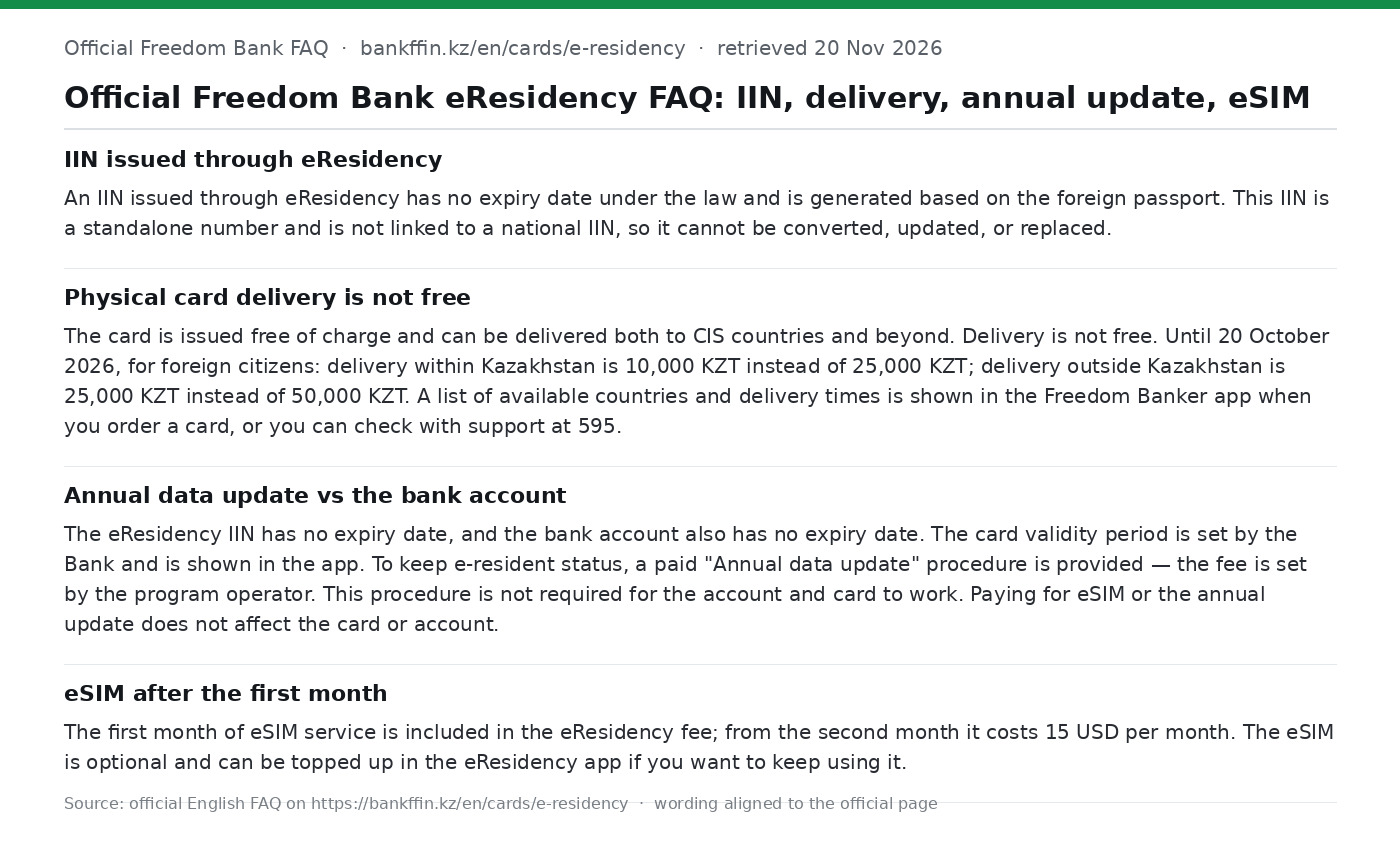
Card validity is set by the bank and is shown in the app. The official FAQ says the bank account itself has no expiry date. If programme status is marked inactive because the annual update was missed, that does not cancel the IIN, but partners will apply their own rules.
Official pages to re-check before you start
- National programme site (Chinese): https://www.eresidency.gov.kz/zh
- National programme site (English): https://www.eresidency.gov.kz/en
- Programme Terms of Use: https://cdn.eresidency.kz/storage/documents/Terms-of-Use
- Freedom Bank eResidency page: https://bankffin.kz/en/cards/e-residency
- Official Freedom Bank support article: https://support.bankffin.kz/eresidency-onlajn-dostup-k-vozmozhnostyam-kazahstana
- Example official Deposit Card tariff PDF: https://bankffin.kz/docs/tariffs_depositcard_en.pdf
- In-country support number: 595
Official fees, eligible nationalities, delivery countries and bank review standards can change. Re-open the pages above and the in-app confirmation screen before you pay. This guide was checked on 20 November 2026 (Asia/Shanghai, UTC+8).