Opening Ant Bank (Macao) in 2026: On-Site Eligibility, Funding the Wealth Account, Macau Pass, and Transfers to Mainland Alipay
A fact-checked guide to opening Ant Bank (Macao), checked against the official website, the bank’s app-store listing, the Monetary Authority of Macao and Alipay
What this guide covers
Ant Bank (Macao) Limited (Chinese legal name 蚂蚁银行(澳门)股份有限公司) is a licensed bank in Macao. Its official site is www.antbank.mo. It is not the same institution as Ant Bank (Hong Kong), and accounts in the two places are not automatically interchangeable.
This guide walks through a common path for visitors who are already in Macao: eligibility for an on-site or in-app application, moving funds into the wealth / securities account, collecting a Macau Pass, and sending money back to mainland Alipay through Alipay (Macao). It complements the published guide to opening bank accounts in Hong Kong and Macau in 2026, which compares several banks on one trip; this article looks at Ant Bank (Macao) in more detail. There is no invented hands-on testing. User reports and screenshots are examples only and are not official promises. Promotions, fees and limits change; rely on the official website, the official app and on-site terms on the day you apply.
This article does not provide any invitation or referral code, and it does not use third-party signup links.
Before you start
- You need to be in Macao. User reports say the application has to be completed while you are physically in Macao, with a location check in the app, and that virtual location tools or common network proxies are not accepted. Being in Hong Kong does not count as being in Macao. Ant Bank (Hong Kong) is a different product.
- The bank account and the wealth account are not the same thing. After the bank account is opened, you usually still have to enable wealth / securities services. Users report that welcome gifts, share vouchers or commission-free offers are tied to assets transferred into and held in the wealth account, not merely to cash left in the current account.
- Documents. You will typically need a mainland China resident ID card, an Exit-Entry Permit for Travelling to and from Hong Kong and Macao, and an entry record that can be verified. Some users say the permit must have more than six months left; other write-ups mention 30 days. This article did not find a single official public figure for the remaining validity, so follow the prompt in the app that day. Entry and exit records can be queried and downloaded, after real-name verification, in the National Immigration Administration mini program “移民局 12367” on WeChat or Alipay.
- Phone and network. You need working mobile roaming or local Wi-Fi. Users report that the mobile number used for the application is best already bound to mainland Alipay, because that binding is used later when you link the Macao account and send a remittance.
- “Open online” is not the same as “no requirements.” The bank’s official app-store listing says you can open an account online with no minimum balance and no account maintenance fee. You still have to complete identity checks and meet the then-current presence, ID and entry-record rules. Traditional Macao banks may also serve mainland visitors, so claims that this is “the only bank in Macao that accepts a mainland ID” are overstated.
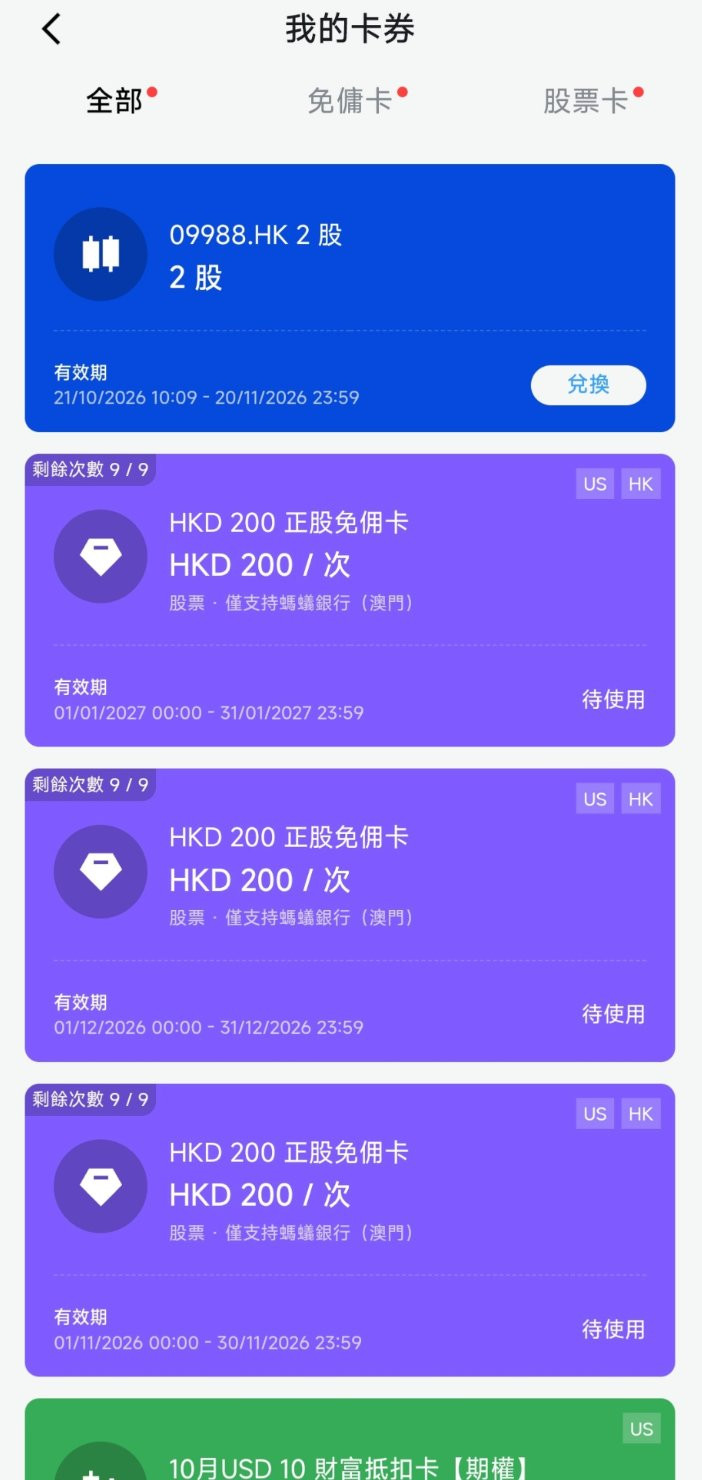
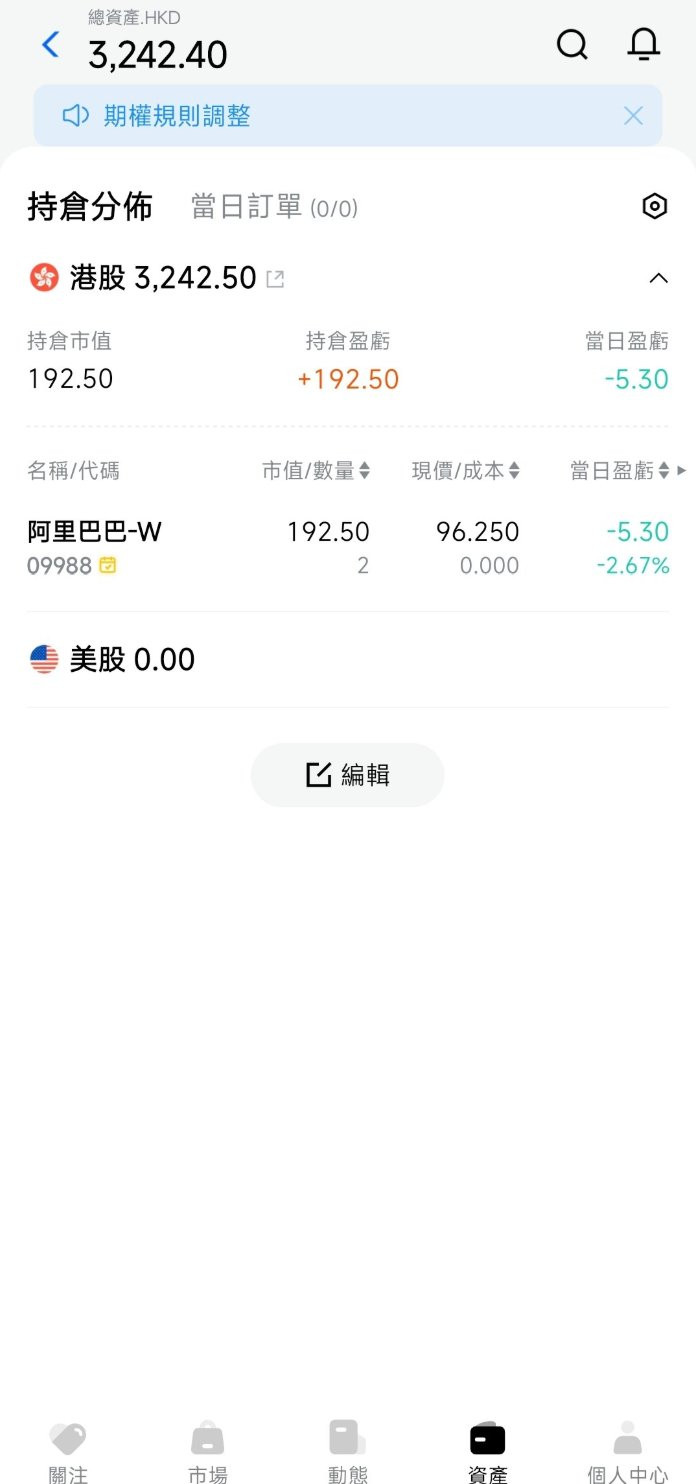
- Promotions expire. Share vouchers, commission-free cards and options credits are short-term campaigns. Interfaces have shown an Alibaba-W (09988.HK) share voucher, Hong Kong-stock commission-free cards and a USD options credit for a given month. Validity follows each coupon and does not mean the same offer is still available.
- No invitation codes. Do not enter an invitation code from an unknown source, and do not follow third-party links that carry invitation parameters. If you want to join an official campaign, go only through www.antbank.mo or the official “Ant Bank (Macao)” app.
Opening the account
- After you enter Macao, if you need an entry record, query it in “移民局 12367” and keep the original file.
- Download the “Ant Bank (Macao)” app from an official store (the Google Play package name is
com.bank.aplus.app.portal; confirm on the official store page). Do not install similarly named apps from unknown publishers. - Follow the app to submit your ID and permit, and complete face or document verification plus the location check. Approval speed varies. Some users report a quick pass; others wait. There is no fixed official turnaround you can rely on.
- After the bank account is open, enable wealth / securities services when the app offers them. If a welcome offer is running, read the rules before you fund the account — especially which account the funds must enter, how long they must stay, and whether early withdrawals void the reward.
The official app-store listing also describes Ant Bank (Macao) as a fully licensed physical and digital bank, and states that deposits are protected up to MOP 800,000. That wording comes from the bank’s own store copy. The actual scope of protection follows the Monetary Authority of Macao (AMCM) deposit-protection rules in force at the time and the bank’s latest disclosures.
Public bank materials list the registered address as 20/F, Zhu Kuan Commercial Centre, 322-362 Alameda Dr. Carlos d’Assumpção, Macao, and the enquiry email as enquiry@antbank.mo. On-site service points are commonly mentioned around Alameda Dr. Carlos d’Assumpção and Galaxy Macau; whether a desk or a kiosk is still handling account opening that day is a matter of on-site arrangements. For transport notes and a broader comparison of banks on the same trip, see the Hong Kong and Macau account-opening guide linked above.
Funding the account and the wealth account
When you send money from a Hong Kong or mainland account to Ant Bank (Macao), separate two possible costs: the sending bank’s wire or interbank fee, and any fee the receiving bank might charge. Ant Bank’s official app-store listing says the bank itself does not charge an interbank remittance handling fee; the sending bank may still charge one.
The table below was compiled from customer tests. The footnote already says the fees come from customer testing. It is not an official fee schedule of Ant Bank (Macao) or of the sending banks. Amounts change with card type, corridor, currency and promotions. Confirm the charge with the sending bank before you transfer.
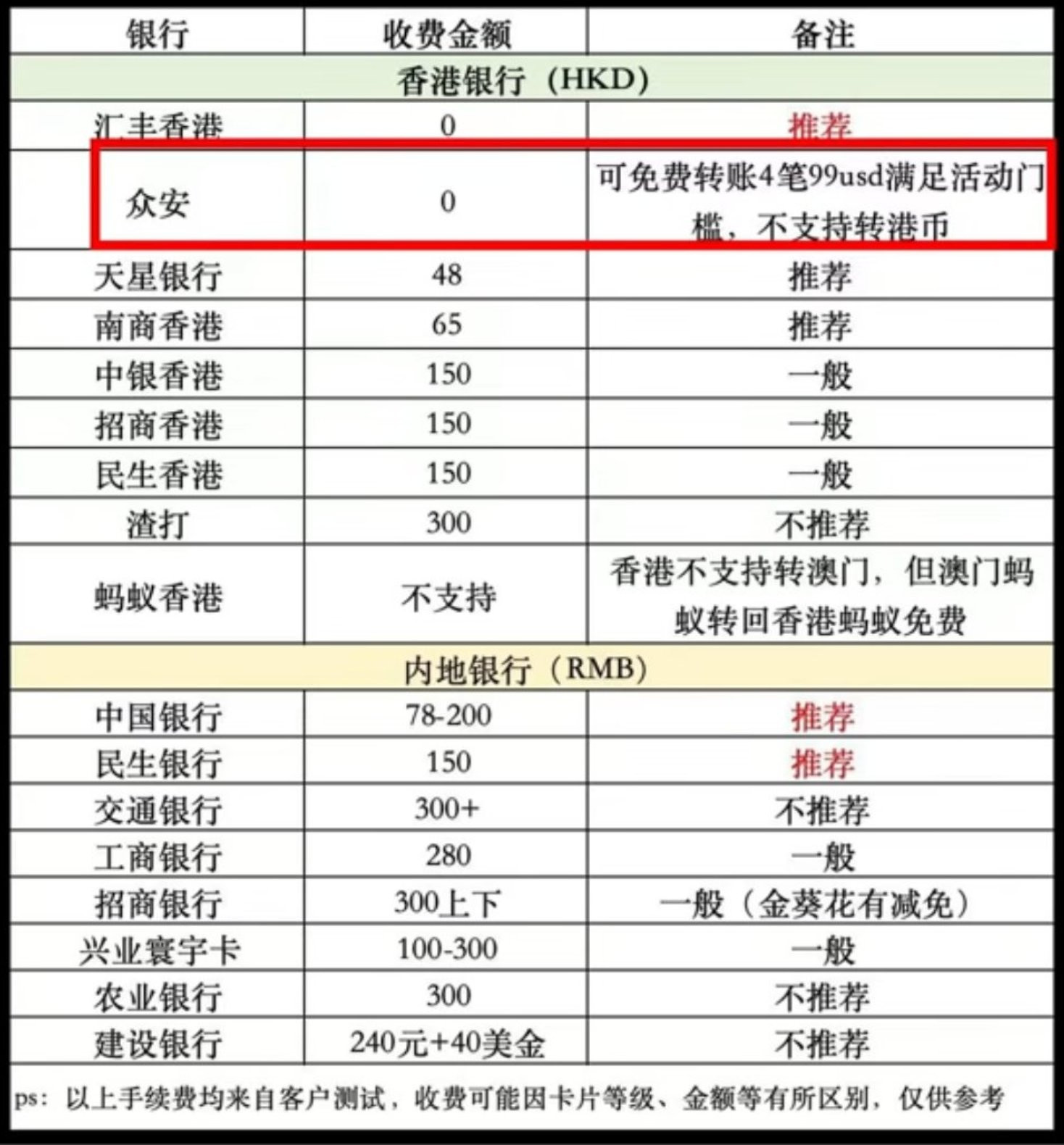
On that unofficial customer-test basis, HSBC Hong Kong was listed at a HKD 0 fee for transfers to Ant Bank (Macao), which is why it is often suggested as a funding channel; ZA Bank was described as offering four free transfers of USD 99 to meet a campaign threshold, without support for sending Hong Kong dollars. This article has not checked each of those figures against the banks’ official tariff books. Whether Ant Bank (Hong Kong) can transfer to Ant Bank (Macao) also depends on the transfer options each bank shows at the time; do not assume the two Ant Bank accounts can move funds freely.
Users report that if a campaign then required assets of about HKD 3,000, the funds had to be moved into the wealth account, not left in the bank account. The published Hong Kong and Macau guide also records one case of depositing HKD 3,200 at an in-branch ATM and transferring it into the investment account. Thresholds, currencies, holding periods and rewards all change; follow the campaign page.
Macau Pass
A Macau Pass is a stored-value transit and payments card. It is not a bank card and cannot be used to withdraw cash from an ATM. Users report that after opening the account they can collect a co-branded or partner Macau Pass at designated locations. Places commonly mentioned include Zhu Kuan Commercial Centre on Alameda Dr. Carlos d’Assumpção, the Asian cuisine area in the east wing lobby of Galaxy Macau, and a hotel lobby that user notes write as 「黄庭海景酒店」. The first two match on-site notes in the published guide. Public tourism listings point to Pousada Marina Infante (皇庭海景酒店, also listed as Royal Infante Harbour View Hotel). Confirm with the bank or on-site staff before you go whether that lobby still handles collection.
Top-up rules and bus discounts follow Macau Pass and local transit rules at the time. One published trip report describes upgrading identity in Mpay, binding the Macau Pass, and topping it up by NFC. Some users also say a card that carries the China T-Union mark can be used on certain mainland buses or metros if it has a balance, within the network that actually accepts it. Do not describe the Macau Pass as a bank card that works without limits on the mainland.
Sending funds back to mainland Alipay
A common path is: switch mainland Alipay to the Macao version (or open Alipay (Macao) remittance from the official page), bind the Ant Bank (Macao) account you have already opened, convert Hong Kong dollars to Macanese patacas if needed, send the payment in patacas, and receive renminbi on the mainland side.
Alipay’s official remittance page describes transfers from Alipay (Macao) to the mainland as safe, real-time and free of handling fees. That wording covers Alipay’s own fee and speed claims for that segment. It does not mean the whole path has zero cost or the best available exchange rate. Conversion spreads, the bank’s exchange rate, and the limits shown in Alipay that day still apply.
Some users report a daily limit of about MOP 30,000 and an annual total of about MOP 250,000, and believe the path does not use the mainland individual’s annual USD 50,000 facilitation quota for purchasing foreign exchange. That is a user report, not an official document. Two regimes need to be kept apart: the annual USD 50,000 facilitation quota mainly constrains purchasing foreign exchange in the mainland and sending it outward; bringing funds that are already overseas back to the mainland is subject to a different set of declaration and bank-review rules. This article cannot treat “it uses none of your foreign-exchange quota” as a fact. How much you can send, and whether it arrives instantly, depends on the limits, rate and notices shown by Alipay and the bank that day.
Do not split payments, use another person’s account, or give an inaccurate purpose in order to get around a limit or a review.
Carddoger takeaway
Ant Bank (Macao) is a reasonable option if you are already in Macao, want a local digital-bank account, and plan either to join a then-current wealth-account campaign or later to send funds back through Alipay (Macao). It does not replace a traditional Hong Kong bank account, and it does not guarantee that a welcome offer will still be running.
Before you apply, make sure you are in Macao with the right documents and entry record, distinguish the bank account from the wealth account, confirm the sending bank’s fees before you fund, and rely only on official limits and rates when you remit to the mainland. Do not depend on a third-party invitation code, or on slogans that promise a cost-free return of funds.
This article was checked on 14 November 2026 (Beijing time, Asia/Shanghai).