Capital One Card Restricted: Identity Checks, Credit Reporting and Closure Decisions
A restriction is not closure—or guaranteed reporting. Verify support contacts, ITIN/address eligibility, payments and FICO history requirements, and avoid unsaf
Start here: restricted is not closed—and reporting is not guaranteed
Capital One distinguishes a temporary restriction or suspension from an account closure. The restriction itself typically does not directly affect scores, but late payments, balances, suspicious activity and a later closure may matter. Confirm the actual status, complete legitimate verification, keep managing payments, check what was actually reported, and only then consider closure. An open but unusable account is not a guaranteed, permanent or cost-free credit-building strategy. R 1
Scope and eligibility: an ITIN alone is not approval or continuing eligibility
This guide concerns existing or prospective Capital One U.S. personal credit-card customers facing a restriction or identity check—not Canadian or U.K. products and not guaranteed remote eligibility. Capital One describes ITIN applications for people living in the U.S. without an SSN. Certain cards may accept ITINs, but identity, address, income and product requirements still apply. Its general FAQ requires a physical address and excludes P.O. Boxes. A residential address means where you actually live; a mailing address may differ. That distinction does not authorize presenting a forwarding address as your residence. Ask the bank which nationality, residence and documentary requirements apply to your case. R 4R 5R 6
Step 1: identify the actual state before taking action
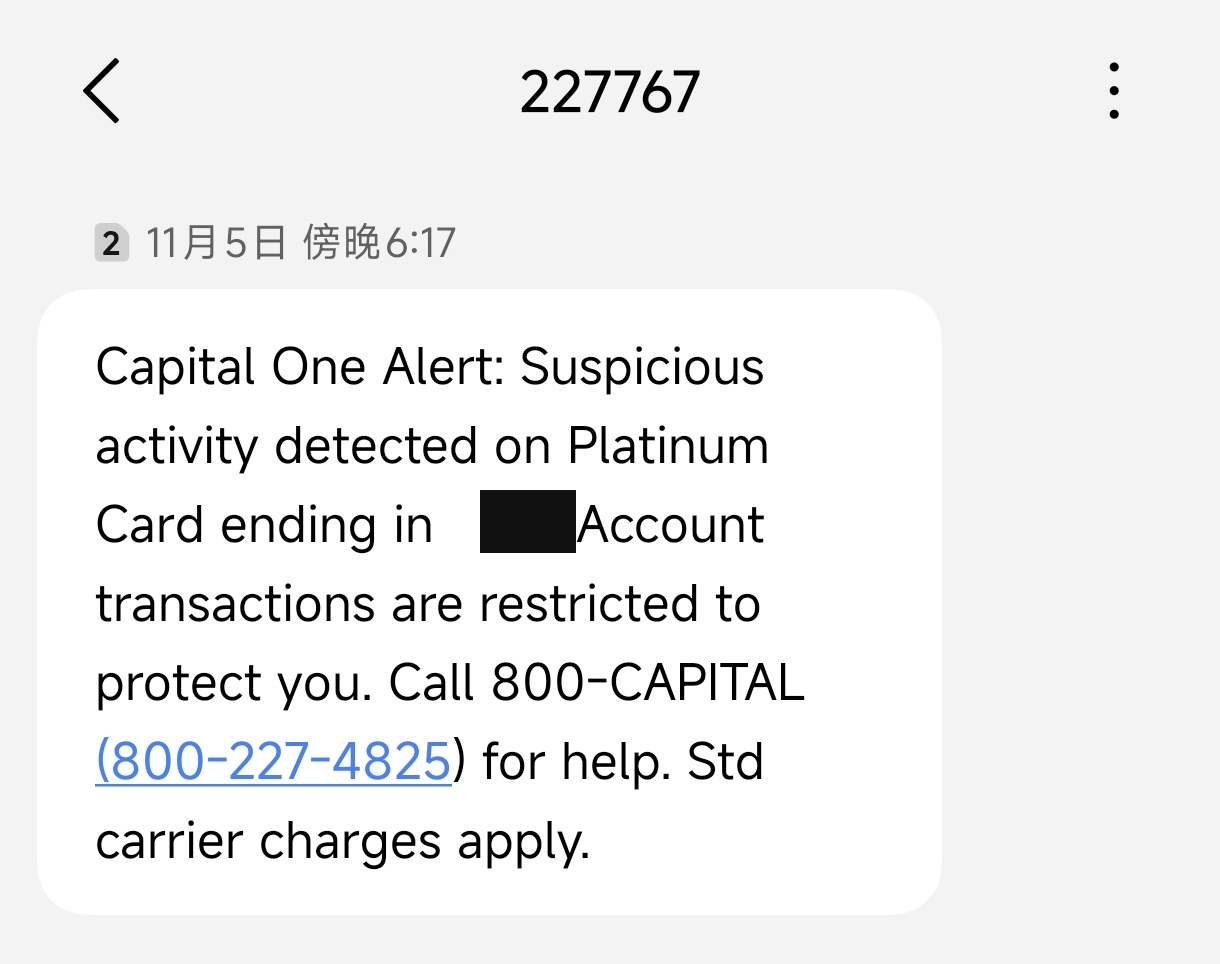
The author’s restriction-alert example,with the card ending additionally masked.The public support number was cross-checked on the official site;a sender label alone does not authenticate an alert.
| What you see | First action | Avoid this assumption | |---|---|---| | User-set lock or one declined transaction | Check app controls and alerts | It is not necessarily a compliance review | | Restricted or suspended | Ask why, case number, documents and deadline | It is not necessarily closed or self-unlockable | | Identity/address review | Use the case-specific secure submission route | Passing a phone identity check is not final approval | | Closed or termination notice | Confirm closure date, balance, payment route and review options | Closure neither cancels debt nor automatically deletes history |
Record notice dates, statement closing and payment dates, and balances. If fraud or credential exposure is suspected, prioritize security rather than trying to preserve an “open” label. R 1R 7
Step 2: contact verified support; interpretation is not identity verification
Verified U.S. card support is 1-800-227-4825. Capital One lists 1-804-934-2001 for collect calls from outside the U.S. Collect calling requires carrier support; not every VoIP call is free. Confirm telecom charges separately. Verify numbers on the official website or card rather than trusting caller ID or a forwarded message. You may ask whether Mandarin interpretation is available, but availability for every case is not verified, and there is no evidence that requesting an interpreter itself proves ineligibility.
If the card has not arrived, say what information you actually have and ask for an alternative verification route. Do not send card numbers, security codes, ITINs, one-time codes, passwords or identity documents to forwarding agents, landlords, groups or general-purpose AI interpreters. Rehearse a credential-free conversation instead. Capital One says it will not request your online-banking password over the phone. R 3R 7
A practical, credential-free support checklist
Ask: 1. Is this account temporarily restricted or already closed?2. What issue needs resolving, and what is my case number?3. Which documents, formats, secure submission route and deadline apply?4. If I lack the requested U.S. document, is there an accepted alternative or review route?5. Will statements, fees or payments continue during review?6. Has the account been reported, and when and with what status?7. If verification cannot be completed, what closure, refund or secured-deposit process applies?
Suggested opening:“My card appears to be restricted. Please confirm whether the account is still open, what verification is required, and how I should keep payments current while the review is pending.” This is a conversation aid—not an unblocking script or a promise from the bank.
Step 3: submit genuine documents through the case-specific secure route
Different restrictions may require different identity, address or income evidence. No universal document list for every restricted card was verified. A branch's general ID policy is not a promise that a remote fraud-review team accepts the same documents; ask that team whether your passport or another genuine document is acceptable. Explain legitimate name/address differences and request proper updates. Never fabricate, buy or edit supporting statements or borrow another person's identity.
The author also warned against false documents. Their suggestion that banks routinely telephone utility companies was speculation, not a verified universal process. Confirm any upload destination through an independently opened official site or verified bank contact. If you cannot satisfy the requirements, ask about legitimate alternatives and account disposition; do not disguise eligibility with proxy locations, false addresses or third-party impersonation. R 6R 7
Step 4: continue managing statements, payments and security
A spending restriction does not suspend payment obligations. Review annual fees, interest, pending or posted transactions, disputes and due amounts, and pay as required by your agreement and statements. There is no single APR, annual fee or verified universal “unblocking fee” for all Capital One cards. Do not apply the illustrated Platinum product's terms to another card or pay an intermediary promising guaranteed reinstatement.
Ask the bank about delivery, replacement and security if the card is missing, returned or exposed. The source's claim of a 99% closure rate after refusing delivery is unverified. Do not let an agent or landlord scan the full card number and security code on the theory that an unusable card is safe to expose. Restrictions do not eliminate later fraud or dispute risks. R 1R 7R 11
Step 5: check actual reporting instead of inferring a clean file
Capital One says it reports account information regularly and must keep it accurate and complete. The reviewed pages do not promise that every unactivated or restricted new card reports on a fixed date or remains in good standing indefinitely. An internal usage restriction and a credit-report status are different concepts, but that does not prove that bureaus or future lenders can never learn relevant risk information, nor prevent later closure or delinquency reporting.
Use official report channels to check whether the account appears and whether identity details, opening date, balance, limit, payments and open/closed status are correct. The three bureaus may update differently. If online identity verification fails, ask the relevant bureau for an official alternative; do not invent an SSN. First-report timing, file matching and reporting across all three bureaus need actual confirmation. R 2
A credit file is not an immediate FICO score
myFICO requires at least one account opened for six months or longer, at least one account reported within the past six months, and no deceased indication. One or multiple accounts may satisfy these criteria, and rare version-specific differences can occur. Seeing a new tradeline on a first statement does not mean an immediate usable FICO score or guaranteed approval elsewhere. Different models, bureaus and lenders' own underwriting decisions are not interchangeable. R 8
Zero utilization is not an automatic high score; do not pay interest to build credit
Utilization generally uses reported balances and limits, not simply an app's live balance. A restricted account can still have prior purchases or fees; zero cannot be assumed. myFICO notes that low utilization may be better than all-zero utilization, but this is not a reason to force spending on a restricted card, bypass restrictions or carry interest-bearing debt. Scores depend on the whole file; no official guarantee ranks every unused restricted card above other beginners' accounts. R 9
Step 6: closure is an individual decision, not a one-or-two-statement rule
Do not close impulsively after one restriction notice, but do not preserve an unsafe, noncompliant or expensive account merely to keep an “open” label. Consider whether genuine verification is possible, fees and balances, continued access to notices and payments, changes to available credit/utilization, and near-term borrowing needs. Confirm the bank's next steps and final statements rather than adopting the author's suggestion to close after one or two reports.
Experian's 29 October 2026 explanation says the “closed at credit grantor's request” notation itself does not directly affect scores. Bank-initiated closure is therefore not automatically a worse scoring category than voluntary closure. Closure, available credit and underlying delinquency may matter. Good-standing closed accounts may typically remain for about 10 years; closure does not erase history or remove accurate negative information. R 10R 11R 2
Step 7: dispute inaccuracies—not accurate unfavorable information
For an account that is not yours, an incorrect balance/payment status or an incorrect closure status, preserve the report and relevant statements and dispute the specific error with Capital One or the bureau showing it. Capital One says it typically responds within 30 days; necessary corrections may take 1–2 billing cycles after investigation to appear. Case-specific and legal timing can differ, and these are not reinstatement deadlines. Accurate late-payment information cannot be removed simply because it harms a credit-building plan. R 2
Source-claim verification table
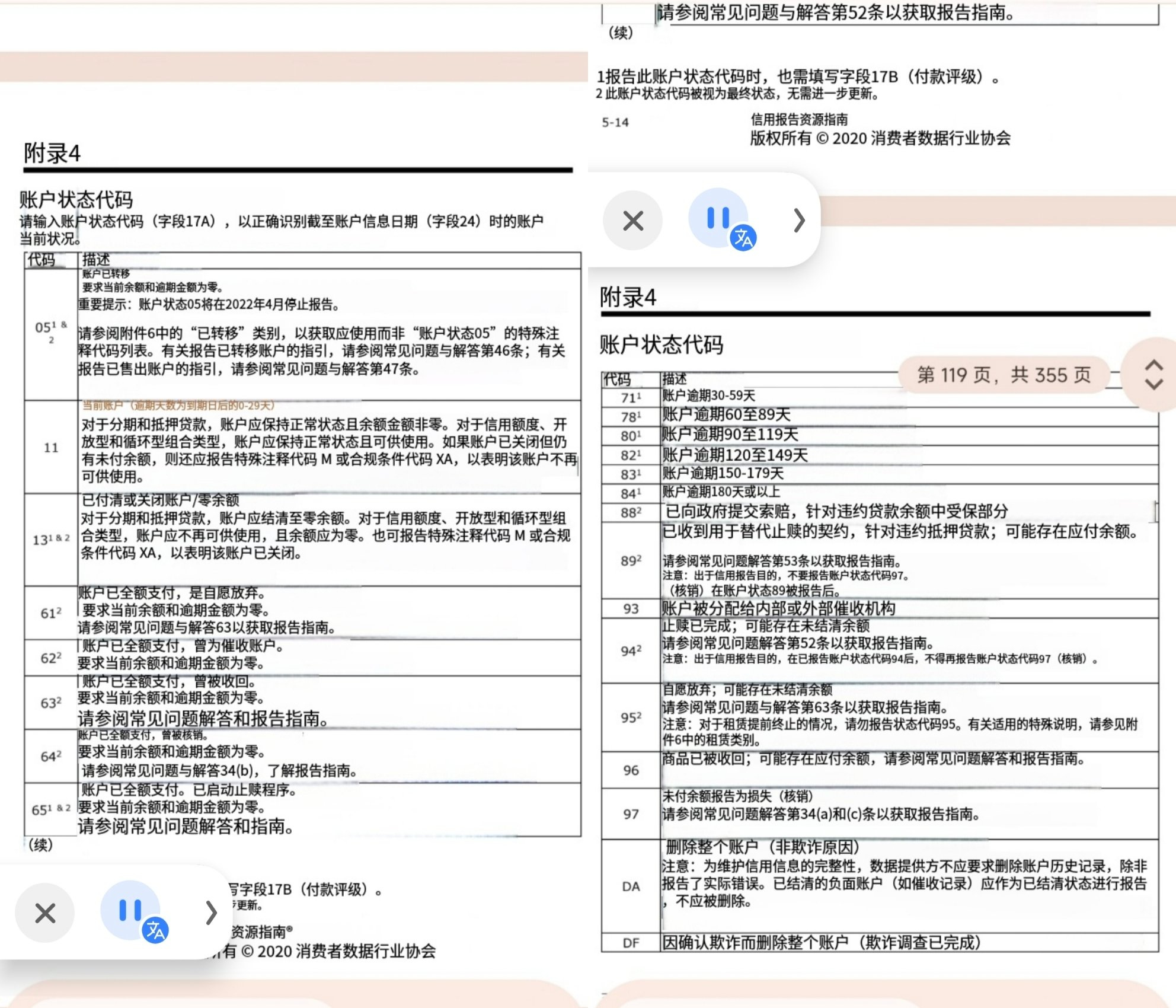
The author’s older status-table screenshot,marked2020;not an authorized current CRRG obtained in this research.It cannot guarantee normal reporting for a particular restricted account.Copyright markings and screen overlays are retained.
| Source claim | Finding | |---|---| | Restriction is not closure | Supported distinction; confirm the individual account | | Every restricted new card will issue the first report normally | No universal guarantee verified; inspect actual reporting | | Only Open, Closed and Collacct statuses exist | Not a complete classification; collections is not every form of bad debt | | No restriction code in CRRG means bureaus know nothing | No authorized full CRRG was reviewed; the absolute inference is unsupported | | All-zero utilization necessarily gives beginners higher scores | Incorrect as a general rule; FICO says low utilization may be better | | Mandarin requests/non-U.S.IPs caused a documented recent crackdown | No verified Capital One announcement/statistics establishing this causation | | Refused delivery causes 99% closure; security-code exposure is harmless | Probability unverified; exposing credentials is unsafe | | Involuntary closure always hurts more than voluntary closure | Not supported; the closure-party notation itself is not a direct scoring factor | | One or two reports guarantee successful credit establishment | No guarantee; FICO minimum-history rules still matter |
Verification scope and limitations
Checked on 8 November 2026, Asia/Shanghai(UTC+8).The source article and its author's conversation replies were read, but their experience and speculation are not bank policy.No personal application, reinstatement or score outcome was tested.Private risk triggers, reinstatement probabilities, universal review times, first reporting for every restricted card, and every nationality/document combination remain unverified.This is informational material, not individualized bank, financial or legal advice.The cover uses the authentic Capital One logo and official Platinum front artwork for brand/card illustration—not proof of the author's or every reader's card model, or bank endorsement.No author referral code or promotional application link is retained.
Official and primary references
- R1 · Capital One:Suspended credit cards
- R2 · Capital One:Filing a credit bureau dispute
- R3 · Capital One:Contact us
- R4 · Capital One:Get a credit card with an ITIN
- R5 · Capital One:Credit card FAQ
- R6 · Capital One:Updating personal account information
- R7 · Capital One:Identity protection
- R8 · myFICO:Minimum scoring requirements
- R9 · myFICO:Credit utilization
- R10 · Experian:Closed at credit grantor request
- R11 · CFPB:Does closing a card hurt credit?
- R12 · Capital One:Platinum official product page
Image scope
The source article contains three body images. This page uses the two acquired and visually reviewed images; one remains unavailable and is neither described nor represented by a broken link or placeholder. The source title cover is archived as source material, not presented as an instruction step. Conclusions rely on the cited official and primary text sources, not on the unseen image.
Source article and author discussion: DaixiXha’s Capital One article. The author’s opinions are not bank policy; the claims above were checked against the cited primary sources.